Heating with infrared radiant heaters: You should know these facts!
March 12, 2026
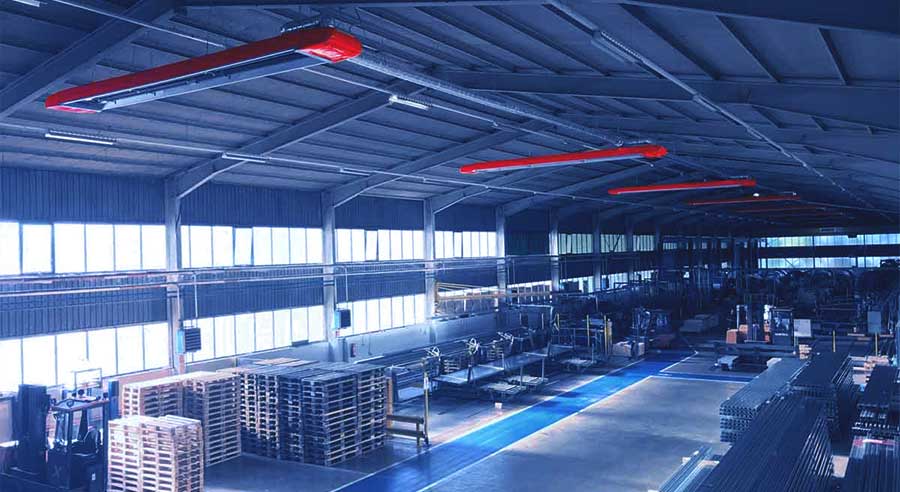
A new heating system for your company's production is a decision that needs to be carefully considered. After all, it's not just about warm halls. There is much more to it than that:
- Saving heating costs sensibly
- Increase energy efficiency
- Creating thermal comfort in the workplace
- Ensure flexibility in operations and
- Fulfill environmental protection requirements and legal requirements
Are you thinking about whether infrared radiant heaters are the right choice? Then these following facts should make your decision easier!
How infrared dark radiators work
Before we get down to the hard facts, we should first clarify two fundamental questions and clear up common misunderstandings. What are radiant heaters and what is the difference between infrared dark radiators and light radiators?
Many of the answers you will find on the Internet are unenlightening or simply nonsense. It is true that both light and dark radiators are radiant heaters, as heat is transferred almost exclusively by infrared radiation. As a rule, natural gas or liquid gas is used as the energy source. However, biogas or hydrogen, e.g. from renewable sources, also have great potential for the future.
Dark radiators use closed combustion in a pipe system. Bright spotlight work with open combustion. The main difference is therefore how the combustion gases are handled: With bright radiators, these initially remain in the hall atmosphere. For this reason, sufficient ventilation must be provided for these systems. With infrared dark radiators, the exhaust air is discharged outside via an exhaust system - without polluting the hall atmosphere. This is why the use of dark radiant heaters is the preferred choice in most applications today.
In both systems, the heat generated is directed into the areas to be heated in the form of infrared rays. Similar to sunlight, heat is generated as soon as the infrared rays hit bodies or objects. This directly heats the hall floor, the room envelope, and the people in the work area, among other things.
The special thing about this is that dark radiators do not heat the ambient air with their infrared radiation, but only directly heat what is actually to be heated. As a result, there is virtually no warm air that rises under the hall roof for physical reasons instead of remaining in the work area. This is precisely the decisive advantage of infrared heaters in terms of efficiency.
No hot air - no air movement
Where there's planing, there's chipping. Or a lot of dust is created. This dust is stirred up by conventional hot air heaters that are often used in halls. This is a problem in many companies, but it can easily be counteracted with infrared dark radiators. These do not heat the air and therefore cannot create draughts or stir up dust. For your employees and visitors, this means a healthy, dust-free and draught-free working atmosphere.
Infrared dark radiators heat particularly efficiently
Let's stay with hot air heating systems, which are usually used in industrial and commercial buildings. Simple physics quickly makes it clear that these are not particularly efficient for heating large halls: After all, the heated air rises straight upwards. To ensure that it is not only warm under the roof, but also in the actual usable area of the hall, it must be continuously reheated. If the hall door is constantly open or the hall is outdated and not sufficiently insulated, this results in an enormous waste of energy and money.
Infrared dark radiators, on the other hand, only heat the objects and bodies they hit, as already described. And if no warm air is generated, no warm air can escape. In addition, the operation of dark radiant heaters can be flexibly adapted to the various situations that work in halls entails by means of a correspondingly intelligent control system:
- Gate opening times
- Working hours and shift times
- Different usage zones in the hall, in which different amounts of heat are required
This means you heat particularly efficiently with infrared radiant heaters. Expressed in clear figures: they consume up to 70 % less energy compared to conventional systems. Modern infrared radiant heaters are therefore probably the most efficient heating systems currently available for industrial and commercial buildings. As a result, you not only quickly recoup the purchase costs, but also do something good for the environment.
Future-proof GEG and GMG-compliant heating: even high efficiency requirements can be safely met with modern infrared dark radiators
Speaking of environmental protection: those who have not taken care of efficient heating systems and other energy-saving measures in their halls in recent years are increasingly being forced into action. This is because in order to achieve the goals of the 2045 climate protection plan, legislators are calling for the economical use of energy in various ways. Important here are
- the GEG Building Energy Act 2024 (still valid)
- the GMG Building Modernization Act (valid from 01.07.2026, planned )
- the CO₂ pricing (still valid)
- the EU ETS 2 (Europe-wide CO2 certificate trading from 2028)
And when it comes to energy management certifications: anyone who wants to pass the audits in accordance with DIN EN ISO 50001 must also meet increasing efficiency requirements.
The GEG will soon be history: it will be replaced by the GMG Building Modernization Act, which will be open to all technologies and will, among other things, abolish the obligation to use 65 % renewable energy sources. In future, oil and gas-powered heating systems will also be permitted if they initially use 10 % renewable energy sources from 2029 - the so-called bio-staircase. Nevertheless, the question remains: does the fact that infrared radiant heaters run on gas contradict the climate targets?
No, on the contrary. This widespread misconception has arisen due to misleading communication about the old legislation and is still causing some uncertainty. The fact is, however, that modern infrared dark radiators have always been used in compliance with the law due to their high energy efficiency - in both new builds and renovations. The GEG 2024 already acknowledges this high efficiency by exempting decentrally heated halls with room heights of more than four meters from the obligation to use renewable energies if annual savings of 40 % and more can be demonstrated. In addition, gas as an energy source not only has a good primary energy factor. Gas is the technology of the future with great potential as soon as the topic of power-to-gas, i.e. the production of hydrogen, becomes a reality., will be available in large-scale industrial processes. Due to their high energy efficiency, gas-powered infrared dark radiators will therefore remain the gold standard for energy-efficient heating of hall buildings in the future. And that pays off in the truest sense of the word.
Dark radiators are an investment that pays off. Right from the start.
One mistake that is made particularly frequently when planning hall heating systems is failing to see the big picture. The new devices should be as inexpensive as possible in terms of investment - and this pays off in the long term if the consumption costs are ignored. After all, a hall heating system consumes x times its investment costs over its life cycle. It is therefore important to also focus on the life cycle costs. The keyword here is: low TCO - Total Costs of Ownership. You can save (or spend!) a lot of money at the wrong end without it being really effective in the end.
So which heating system is worthwhile - even in the long term? The answer is: the heating system that best suits your usage profile and meets your economic requirements. Compared to many other systems, infrared dark radiators are characterized by low investment costs. This is confirmed by the results of a study that we carried out together with the Technical University of Kaiserslautern. Investment costs for the use of renewable energies such as a heat pump in conjunction with underfloor heating or a wood pellet stove coupled with radiant ceiling panels are between a factor of 1.8 and 4.0 - on average a factor of 3.0! - higher than with a dark radiator system with residual heat utilization.
As already mentioned, infrared radiant heaters also score highly in terms of efficiency and low annual energy requirements. The investment costs are amortized after just a few years. A dark radiant heater therefore clearly pays off in most halls.
With infrared heating, you are making a secure investment in the future of heating technology.
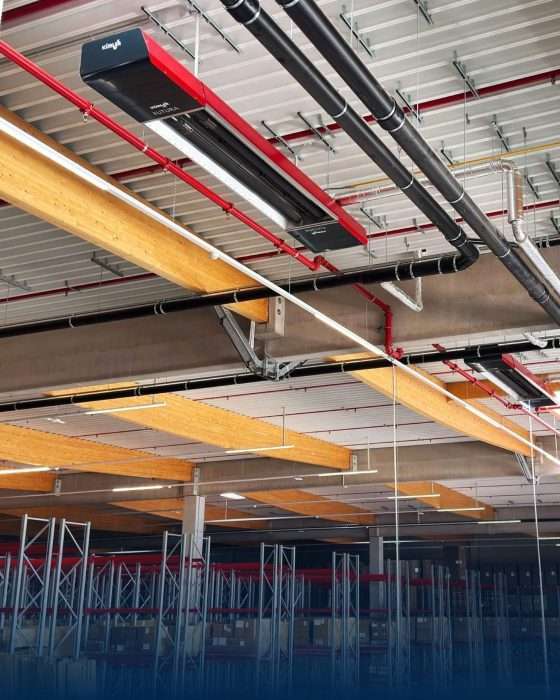
Infrared heaters can be powered by gas, but they don't have to be. Recently, renewable energies such as electricity or hydrogen have also become viable options. This is made possible by a new technology called Fair.AIdH (Energy Flexible, adaptive, infrared, AI driven, Hall heating). This new development offers the energy efficiency of KÜBLER's most powerful dark radiant heater and uses infrared for heat transfer, but goes far beyond classic dark radiant heater technology: instead of gas, it is heated in an energy-flexible manner using various energy sources such as PV, mains electricity, biogas, or hydrogen – in mixed or mono operation. Natural gas or liquid gas can be used as backup energy, e.g., when dark doldrums need to be compensated for. Control is provided by intelligent AI-supported technology. And those who wish to can equip their heating system as a 2-in-1 system with integrated LED hall lighting. This almost halves the costs for infrastructure and maintenance and further increases the sustainability of the solution. Infrared hall heaters with the new Fair.AIdH technology include the multi-award-winning FUTURA and FUTURA E lines. ELEXTRA is also a purely electric device series for 100 % CO2-free heating. Many hall operators will be interested to know that, thanks to the new Fair.AIdH technology, the major advantages of infrared technology can still be exploited. All systems with Fair.AIdH are GEG-compliant and designed to implement decarbonization along the transformation path as economically and functionally as possible.
Achieve personal and energy policy goals with dark radiators
Regardless of whether your hall is four, ten or more meters high: dark radiators are a sustainable investment that will not only increase the satisfaction and productivity of your employees, but also help you to meet energy policy targets thanks to their high efficiency. Find out more here. If you would like to talk about concrete plans now, Let's have a conversation and discuss the different requirements of your industry.
Everything you need to know about energy-saving hall heating systems in practice
Saving energy is a big issue - across all sectors. If you want to put an end to inefficient heating systems, our guide is just right for you!
Request a free guide
You might also be interested in
-
 Operators of indoor heating systems are also responsible for having their system serviced regularly. In addition to operational safety, there are other good reasons why maintenance should not be put on the back burner!
 -
 The German government is sticking to its goal of climate neutrality by 2045. The GMG is to come into force on 01.07.2026. The EU Buildings Directive (EPBD) will be implemented 1:1, making full use of national leeway. The requirements of the Heating Act (GEG §§ 71-71p) will be deleted. The obligation to operate new heating systems with at least 65 % renewable energy will no longer apply to new and existing buildings. Technology openness: Owners [...]
 -
 Germany has a huge number of buildings whose heating systems waste energy every day and produce far too much CO₂. With regard to the use of renewable energies and modern technologies, it is by no means just an old stock that urgently needs to be refurbished. Many newly built halls are also equipped with outdated [...]
 -
Mr. Kübler, your company produces heating systems for halls. These only make up a small proportion of all buildings in Germany. Why is it nevertheless important to save as much energy as possible in this area? That's right, halls only make up around 1.5 percent of all buildings in Germany, so most people don't notice them. Even [...]