Infrared technology for warehouses and production halls
February 11, 2026
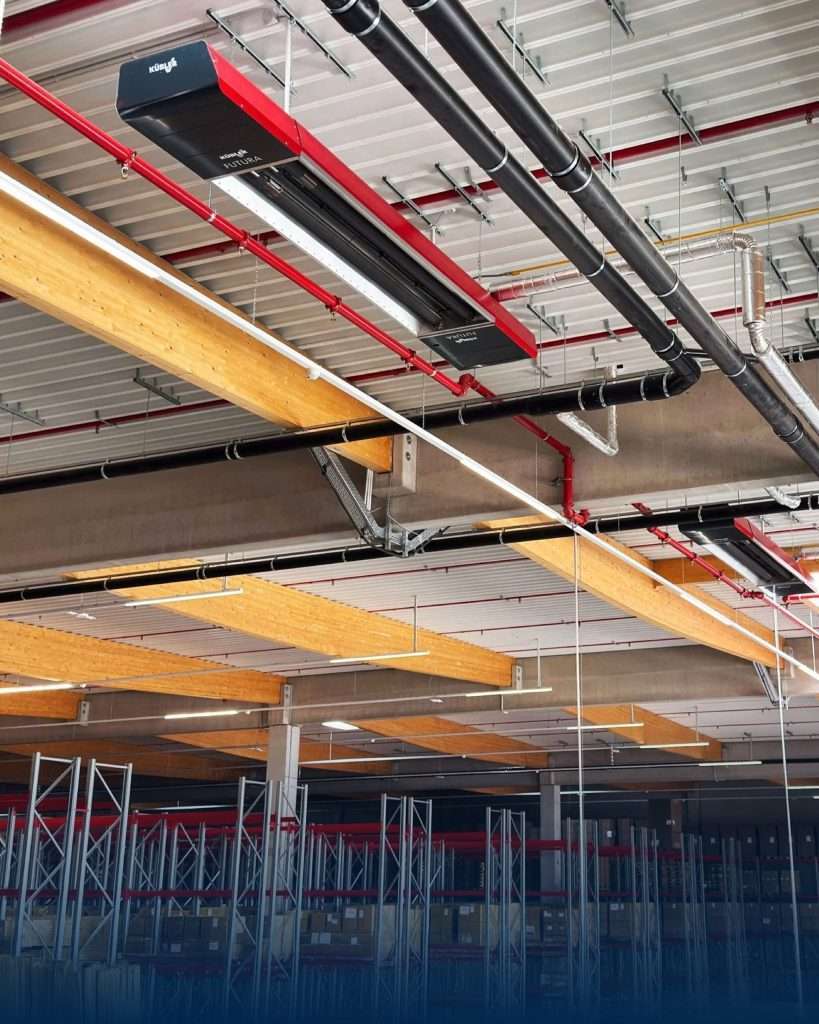
In the coalition negotiations, the party leaders committed to maintaining Germany as an industrialized country and at the same time making it climate-neutral. In addition, the new federal government has promised to keep energy costs moderate in the future. What is important now are innovations that target Germany's largest energy consumers in order to achieve significant savings.
Germany has a huge number of buildings whose heating systems waste energy every day and produce far too much CO₂. With regard to the use of renewable energies and modern technologies, it is by no means just an old stock that urgently needs to be renovated. Many newly built halls are also heated with outdated technology.
For real estate funds and developers, renting out halls is a very good business. Large European real estate providers own millions of square meters of warehouse space. They find tenants particularly along the European highways, at important logistics hubs such as airports or freight stations.
And the industry's growth is far from over. Due to the ongoing boom in online retail, warehouses and logistics centers are in high demand. Providers are constructing standardized buildings with shelving, digital control and heating as cheaply as possible, market analysts criticize. It is true that the halls are built in compliance with regulations. However, this does not mean that they are up to date in terms of functionality, according to the criticism.
In particular, the technologies used for heating, the chosen energy supply and energy consumption mean that such quickly and cheaply constructed buildings are often not considered particularly efficient. And cheaper heating systems often mean that tenants have to heat with expensive electricity or fossil fuels.
Standardized and cheap leads to high costs
Although standard hot water heating systems have been used for decades, they are not suitable for halls in many cases. The enormous room heights alone mean that they consume an unreasonable amount of energy. When tenants heat large warehouses or production halls, they offer hardly any flexibility, are difficult to regulate and can only be controlled digitally or with AI to a limited extent. The heat collects under the hall ceiling throughout the day. If the doors for loading trucks are open, it escapes to the outside. In addition, conventional heating systems are often considered uneconomical and of little use. This means that this solution, which is inexpensive to build, can quickly become a cost-intensive problem for those responsible in logistics companies - after all, around 70 percent of energy consumption in a typical industrial building is heating costs. Expenses explode with expensive purchased electricity. This is why the management attaches particular importance to the energy balance from heat generation. And defines the use of the most environmentally friendly and energy-efficient solutions possible as a strategic asset. No wonder that many hall users quickly reach the point where they want to use more efficient heating systems.
Strategic operating facility
Owners support the energy revolution with modern technologies. Heating with infrared technology can be one solution. For many, it stands for high efficiency and the ability to heat different work areas within a hall in a targeted manner. The new so-called energy-flexible systems make it possible to switch between energy sources and suppliers. The system switches to the best supply available at the time: for example, PV electricity from the building's own roof or cheap mains electricity, it works with hydrogen or with other gases available on the market.
Why do industrial heating systems need a technical revolution?
KÜBLER presented nothing less than the „hall heating revolution" at the world's leading trade fair ISH 2025. The innovation and technology leader has been setting the standards for climate-friendly heating systems for halls for more than 35 years, combining the demand for environmental protection with the need to offer functional and highly economical hall heating solutions to industrial and commercial companies that are burdened by multiple burdens.
What exactly is behind the „hall heating revolution" and what future requirements does the new Fair.AldH technology (Energy Flexible adaptive infrared Al driven Hall heating) for hall heating systems meet? We asked the Managing Partner of KÜBLER Energiesparende Hallenheizungen, Thomas Kübler.
Two years ago, you launched FUTURA, the first multi-energy infrared heating system on the market. What's new today with the „Revolution indoor heating"?
„Hall heating revolution" is the answer to the challenges of the future when it comes to heating halls. This is what the new Fair.AldH technology stands for. It means the highest possible energy efficiency - important for the cost side and the exploitation of economic advantages. And it neutralizes the volatility of renewable energies by working with different forms of energy and combining this with the practical usage requirements of the operator of hall buildings. On the one hand, we have volatile forms of energy such as PV electricity. We have to mix these in the transformation phase, for example with gas, i.e. with existing forms of energy that are reliable and available at all times. In most cases, electricity cannot be drawn from the grid in sufficient quantities and is certainly not affordable - just think of dark doldrums!
You are talking about gas. What role will hydrogen play in the future?
At the moment, hydrogen is still a niche topic. But that will change in the next 10 or 15 years at the latest. I'll just mention the keywords hydrogen core network, affordable electrolysers and upgrading the gas network. We see great potential here - especially for industry. For this reason, we have designed the Fair.AldH systems in such a way that they can be operated not only with electricity from various sources, but also with hydrogen.
How can the use of different heating energies be controlled in one system?
At least until renewables are available across the board and affordable, we need to manage the different forms of energy across the transformation. And this, in turn, must be well married to user behavior in order to be functional and sensible. In other words: When do people work? Where do people work? The basic prerequisite for high energy efficiency is to only heat when heat is actually needed. This requires intelligent, Kl-supported infrared systems that are technically capable of achieving this. There is still a great deal of potential to be tapped into here in terms of user comfort and energy efficiency.
The industry is under great cost pressure. What contribution can hall heating make here?
We have learned that grid electricity becomes incredibly expensive during dark doldrums. Of course, energy flexibility must therefore also be considered in terms of costs and energy expenditure. We have cheap PV electricity, we have grid electricity with volatile prices and, of course, we traditionally have the price of gas with rising C02 prices. At KÜBLER, we see the new challenges in heating halls as meeting three basic requirements: firstly, making heat available, secondly, managing the forms of energy and thirdly, reconciling prices with user behavior in real time. These are the greatest challenges of the future, demanding new capabilities from hall heating systems that are far removed from the outdated functionalities of hot water piping systems.
„The new technology is so intelligent that it can absorb and cushion all the challenges of the energy transition." Thomas Küb/er talks about the big five of the energy transition: Energy flexibility, decarbonization, volatility of renewable energies, energy self-sufficiency and hydrogen. He also talks about the ways in which Fair.AldH developments such as FUTURA, ELEXTRA and other KÜBLER innovations can make them manageable and, importantly for companies, economical and affordable.
How would you summarize the advantages of the new Fair. AldH technologies?
Fair.AldH combines the requirements of the heating transition with those of the operators in terms of economy and comfort. The new technologies can use the currently cheapest energy source in an energy-flexible manner today and heat 100 percent C02-free tomorrow. The systems are Kl-supported and virtually unsurpassed in their efficiency. They offer absolute investment security and at the same time are world champions of sustainability: because of their economical consumption, because they can integrate hall lighting as a 2-in-1 system, but also because they do not require refrigerants and do not cause any noise emissions. In addition, Fair.AldH technologies are unique in their usability - whether in new or existing buildings.
Everything you need to know about energy-saving hall heating systems in practice
Saving energy is a big issue - across all sectors. If you want to put an end to inefficient heating systems, our guide is just right for you!
Request a free guide
You might also be interested in
-
 A new heating system for your company's hall is a decision that needs to be carefully considered. Read this article to find out which facts speak in favor of an infrared radiant heater!
 -
Operators of indoor heating systems are also responsible for having their system serviced regularly. In addition to operational safety, there are other good reasons why maintenance should not be put on the back burner!
-
 The German government is sticking to its goal of climate neutrality by 2045. The GMG is to come into force on 01.07.2026. The EU Buildings Directive (EPBD) will be implemented 1:1, making full use of national leeway. The requirements of the Heating Act (GEG §§ 71-71p) will be deleted. The obligation to operate new heating systems with at least 65 % renewable energy will no longer apply to new and existing buildings. Technology openness: Owners [...]
 -
 Mr. Kübler, your company produces heating systems for halls. These only make up a small proportion of all buildings in Germany. Why is it nevertheless important to save as much energy as possible in this area? That's right, halls only make up around 1.5 percent of all buildings in Germany, so most people don't notice them. Even [...]