Innovative hall heating project is dena's latest example of good practice
January 31, 2025
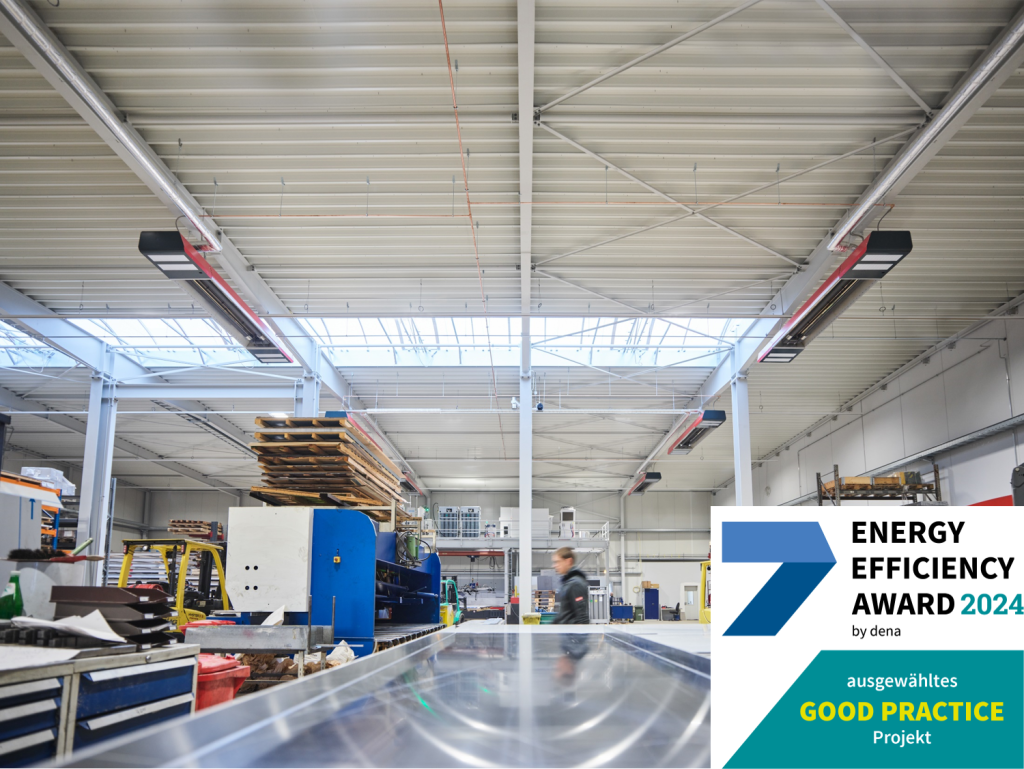
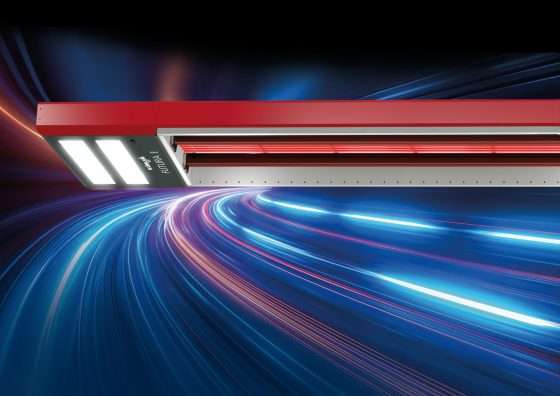
With the Good Practice Label, the German Energy Agency (dena) recognizes exemplary measures for successful energy saving. The good practice examples are intended to inspire other companies and motivate them to follow suit. The most recent example is the heating project in the new building of the metal processing specialist Die Kanter & Schlosser in Trier. The innovative FUTURA multi-energy system from KÜBLER was used.
The company had set the highest energy efficiency standards for its new building. Initially, the new production building was to be heated by a combination of heat pump and underfloor heating, but this proved to be less functional in hall buildings. The decision was made to use the completely new energy-flexible infrared system FUTURA from KÜBLER - as a pilot project. "We are always breaking new ground ourselves with many of our projects. We are happy to help shape the process at KÜBLER," says Christoph Rotsch, Managing Director. "When we got to know the FUTURA, underfloor heating was off the table."
Two heating periods later, Kanter & Schlosser is still very satisfied. "A big advantage for us is that we can now heat with different energy sources," explains the company. With the FUTURA system, Trier is no longer exclusively reliant on gas. In the first heating period, the photovoltaic system took over the entire heating costs from around 11 a.m. onwards. Previously, the heating in the old building would have blown circulating air into the hall. Every time the door was opened, it immediately became very cold and it felt like it took an eternity for the temperature to return to normal. "Now we definitely have a much more pleasant heat quality in the hall - precise, without swirling up dust. This is very well received by the employees."
Another important advantage is the ability to heat the individual areas of the hall individually or switch them off when work is no longer taking place there. "We have set up four heating circuits that we can control via the FUTURA system. That saves a lot of energy. Especially when, for example, the metalworking shop closes early on Fridays and we can switch off the heating in this area," says Christoph Rotsch. Wasting energy is not an option for the future-oriented company. For this reason, Die Kanter & Schlosser is also happy to no longer be reliant on technologies such as underfloor heating, which cannot be controlled according to demand and have to run at night or at weekends.
All details about the measures, savings and results of the award-winning hall heating project can be found on dena's good practice page at this link: Energy-saving hall heating
Everything you need to know about energy-saving hall heating systems in practice
Saving energy is a big issue - across all sectors. If you want to put an end to inefficient heating systems, our guide is just right for you!
Request a free guide
Interested in our press photos?
Would you like to download all images from the article in the highest quality? Simply click on the button below and enjoy our press photos in the highest resolution!
You might also be interested in
-
 While the public debate has so far focused heavily on residential construction, specific questions arise for industrial and logistics companies: what are the implications for large-volume non-residential buildings such as production and logistics halls? Thomas Kübler, an expert in energy-efficient hall heating systems, explains the key points from a practical perspective. Climate neutrality remains the guiding principle The German government is sticking to its goal of climate neutrality [...]
 -
 „Anyone who is nominated for the ‘Großer Preis des Mittelstandes’ belongs to the elite of German SMEs. This nomination alone is already an award of the highest quality,“ emphasizes Barbara Stamm, President of the Bavarian State Parliament. Outstanding achievements in five areas In the competition, the KÜBLER company is assessed in its entirety and its role within society. The [...]
 -
 Ludwigshafen - Clear messages, clear expectations: At the annual reception of the Rhineland-Palatinate Economic Council at the main site of KÜBLER GmbH, host Frederic Renz had clear words to say about the economic situation. „SMEs need what all companies in Germany urgently need: a clear direction and reliable political framework conditions. If you want economic growth, you have to create planning security,“ emphasized the Managing Director of the hall heating specialist. Around [...]
 -
 Heating halls efficiently, economically and functionally is a challenge. Because in these huge buildings with ceiling heights that often reach 20 meters, a lot of energy can quickly be consumed - energy that is expensive and, depending on the heating technology used, also causes high emissions. The building stock is often still equipped with inefficient and [...]