GROUP7 is an international logistics company headquartered in Munich and represented worldwide with over 195 branches and bases. The premium service provider's range of services includes intelligent logistics solutions for air freight, sea freight, rail transportation to and from Asia, sea-air and land transportation, as well as individual concepts for outsourcing in the logistics services sector. With a focus on maximum flexibility and customer-oriented process handling, around 750 employees generate a turnover of 190 million euros. GROUP7 places the same high demands on the sustainability of its portfolio as it does on its buildings: the logistics centers of the renowned logistics provider are certified in accordance with the DGNB Gold Standard.
The initial situation
With the expansion of the main headquarters in Schwaig at Munich Airport, GROUP7 2024 has created a new logistics location in accordance with the DGNB Gold Standard, which will provide work for more than 200 new employees. In addition to a 5,000 m² office building and a campus-style green park, the additional site covers an area of over 100,000 m² and includes a 60,000 m² logistics hall with a ceiling height of around 13 meters. The very large air space and the total of 82 doors alone made it a particular challenge in terms of heating technology to keep the interior pleasantly warm while remaining economical. In addition, however, the change in the supply situation meant that gas as an energy source, and therefore the tried and tested dark radiator technology, was no longer an option for the new hall. Various alternative solutions were therefore examined.
„We have found that FUTURA is simply the perfect solution for us in terms of use.“.
The tested heating technology variants
Variant 1: Heat pumps installed on the roof and fitted with underfloor heating. However, GROUP7 had had bad experiences with this option in the past, as „the heat from below“ had made employees feel uncomfortable and uneasy. There were also other reasons why this option should not be considered:
A) The necessary variable rack setup: Every time the intralogistics system is adapted to new customer requirements, there is a risk of drilling into the water pipes in the floor when anchoring the 10 to 11 m high uprights.
B) The large quantities of concrete required above the water pipes would have made the systems increasingly inefficient and sluggish. And
Variant 2: Heat pumps with jet nozzles on the ceiling that press warm air onto the floor panel. The disadvantage of this solution was that warm air rises upwards, taking dust from the floor panel with it and spreading it over the goods - a particular problem with so-called C-goods, which are stored for long periods of time. For the premium logistics service provider GROUP7, the heat roll that would be created in the building was unacceptable, „... because we want to offer high-quality logistics and not dusty goods - that is not our quality standard and not that of our customers,“ says Daniel Jocher, Project Manager at GROUP7.
Variant 3: A system configuration consisting of gas-powered dark radiators next to which electrically powered electric IR radiators are placed. This variant would have offered the well-known advantages of radiant heating, such as the uniform heat sensation without dust circulation and without heat from the floor slab. From GROUP7's point of view, however, this was not a sensible solution either, as the number of radiators in the hall and the maintenance effort would be doubled
would have. Heat distribution would also be problematic, as the alternately installed dark and electric radiators should not be operated at the same time and coolness would develop in the gaps. In addition, GROUP7 did not want to use purely gas-powered appliances.
The innovative solution
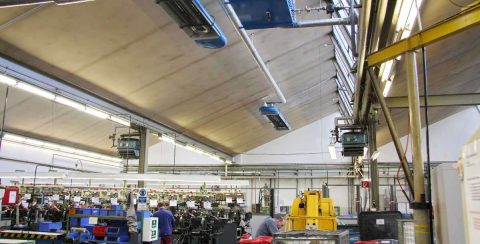
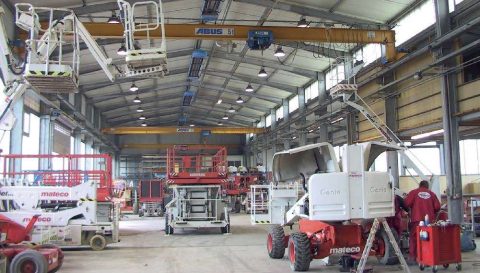
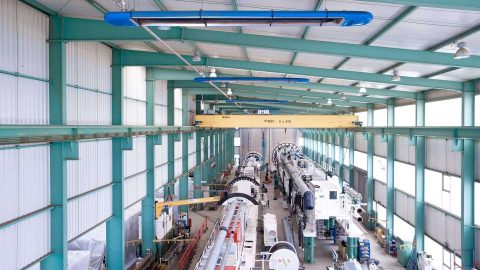
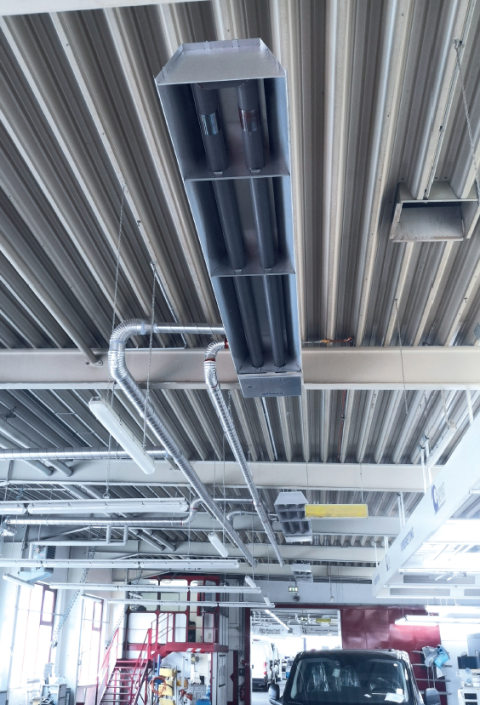
The search for suitable heating technology led to the new Fair.AIdH technology* FUTURA. The multi-award-winning system combines all the advantages of dark radiator technology in halls with energy-flexible operation: it consumes extremely little energy, does not stir up any dust, ensures a pleasant, uniform feeling of warmth and variably combines electricity and gas operation in one device. „We realized that it was simply the perfect solution for us in terms of use,“ says Daniel Jocher. It was clear that we needed gas as a redundancy medium to cover the dark doldrums. FUTURA is largely powered by the low-cost electricity from the company's own PV system. Looking to the future, the innovative technology also offers a solution with hydrogen, which could later be distributed through the grids. „This product is a great combination because it brings together all three media.“
* Fair.AIdH stands for Energy Flexible, adaptive, infrared, AI driven Hall heating and
refers to a new infrared heating technology that is characterized, among other things, by its
energy flexibility (multi-energy IR hall heating) and through AI-supported
control functionalities fundamentally differ from the conventional gas-powered
dark radiator technology.
The basis for the decision
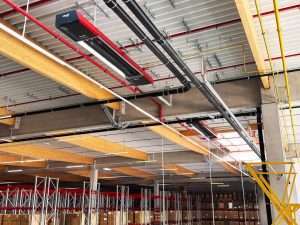
Energy-flexible infrared hall heaters from the FUTURA range
„The decision was made due to the combinability of electricity and gas,“ says Daniel Jocher. The aspects of operational reliability and switchable power were also relevant, as it was clear that gas is a relevant redundancy medium in order to remain independent of expensive grid electricity due to dark doldrums or possible blackouts. It was also interesting to look at hydrogen, which could be distributed in the grids in the future. „The ability to combine electricity and gas as a redundancy medium provides operational reliability on dark days or when there is a snow load, as we don't have to draw expensive electricity from the grid. Even against the backdrop of a possible blackout, security of supply would still be guaranteed with the redundancy medium and PV.
guaranteed. That was important to us.“
In summary, these factors were also decisive for the decision:
- The ability to combine electricity, hydrogen and gas in one device (energy flexibility)
- Local heating only in the areas where work is actually carried out (flexible zone heating)
- Reliable basic temperature control as frost protection for goods
- Constant heat supply even in dark doldrums (operational reliability)
- Investment and future security over the coming decades
„We wanted a product that looks to the future.“ FUTURA can be operated flexibly with different (renewable) energy sources such as electricity, hydrogen or (biogenic) gases and therefore offers GROUP7 absolute investment security
on the transformation path to a CO2-free era - far beyond 2045.
The realization
Since December 31, 2024, the five hall sections have been heated with appliances from the energy-flexible Fair.AIdH systems (FUTURA multi-energy IR heating with CELESTRA digital control), which are supplied with electricity entirely via a PV system with a capacity of around 3 MWp.
The «Schwaig 2» logistics center was divided into 12 heating zones according to the hall sections. This allows the different usage areas of the impressive hall building to be controlled individually depending on the heat requirement, which further increases the already high energy efficiency of the system. The heaters in the individual zones are each controlled by an AI-supported CELESTRA digital controller. The systems can intelligently control which heating media are used in each zone.
and schedule the stored rates. Non-working times such as weekends and public holidays are automatically taken into account.
The EMMA energy management system monitors the entire heating process and temperature curve from inside and outside for each heating system in real time and analyzes and documents the data for audits, e.g. according to DIN EN 50001, according to
which is also GROUP7 certified. This means that consumption, temperatures, humidity and other quality indicators are available at all times for documentation and verification.
First experiences from operational practice
The heating system runs during the day from 9 a.m. to 5 p.m. in electric mode at 20 °C. The first few months of operation have shown that the approximately 3 MWp PV system easily covers the electricity requirement of 760 kWh during this time, even when it is cloudy. From 17:00 h onwards, the system is switched off in this way and the heating system is theoretically regulated down from a working temperature of 20 °C to 17 °C (set target temperature at night). In reality, however, it has been shown that there is virtually no temperature reduction at all due to the building's good heat storage capacity.
DGNB Gold Standard

The hall heating system in the new logistics property «Schwaig 2», consisting of Fair.AIdH FUTURA devices and digital controls from the CELESTRA line, fits perfectly into GROUP7's sustainability concept, which relies on
and ecologically far-sighted planning and use and therefore certifies all new construction projects in accordance with DGNB. The German Sustainable Building Council (DGNB) examines ecology, economy, technology, process and location and also evaluates the infrastructure and life cycle of GROUP7 logistics properties.
„It was important to us that we only heat the areas where people are actually working.“
Conclusion
The results
„Our first conclusion is that we are very satisfied with both the way the heating is installed and the implementation. The collaboration was very cooperative and solution-oriented,“ says Daniel Jocher. The project was completed smoothly in two construction phases with a fixed schedule. Halls C, D and E went into operation on 23.12.2024, Halls A and B on 31.03.2025.
As there were still too few reliable figures available after the first few months of operation, a comparative calculation was drawn up for the efficiency assessment and the accompanying architectural firm Jochen Peitz, Remscheid, was commissioned to do this. In the calculation, the
theoretical consumption values of the FUTURA Fair.AIdH system were compared with other heating variants.
Conclusion of the comparative calculation:
The gigantic hall with a ceiling height of around 13 meters is significantly below the energy consumption of a KfW40 building, has an annual saving of 324 MWh, which is 14.25 percent better in terms of primary energy consumption than the heat pump-air heating alternative, and is on a par with the latter in terms of final energy demand (21.9 vs. 21.10 kWh/m²a). The conclusion: In a theoretical comparison of the final energy requirement in accordance with DIN V 18599, the FUTURA Fair.AIdH and heat pump systems are on a par.
In practice, it is expected that the FUTURA system will be even more clearly differentiated from the heat pump-air heating variant in terms of energy. This is because the theoretical calculation does not take into account a) the fact that 50 % gas operation was assumed here, but in fact 100 % is only heated with electricity and b) the more efficient functions of new, digitized systems. A study by the Fraunhofer Institute for Solar Energy Systems (ISE) shows that the measured savings values in reality are more than 1.6 times better than would currently be expected on the basis of the outdated DIN V 18599 standard.
GROUP7 Project «Schwaig 2» | Results of the comparative calculations
In the comparative calculation by architects Jochen Peitz, the primary and final energy requirements of the new Fair.AIdH technology FUTURA (operating mode electricity/gas 50:50) were compared with four other heating systems: Autonomous air heating,
Dark radiators gas-powered, air heater-heat pump electricity-powered and air heater-heat pump gas-powered.

Notes and results:
The electric infrared heating system = Fair.AidH technology
FUTURA has the lowest primary energy requirement.

Notes and results:
The hall heating system with Fair.AidH technology FUTURA is almost
equivalent compared to the electricity-powered heat pump system.