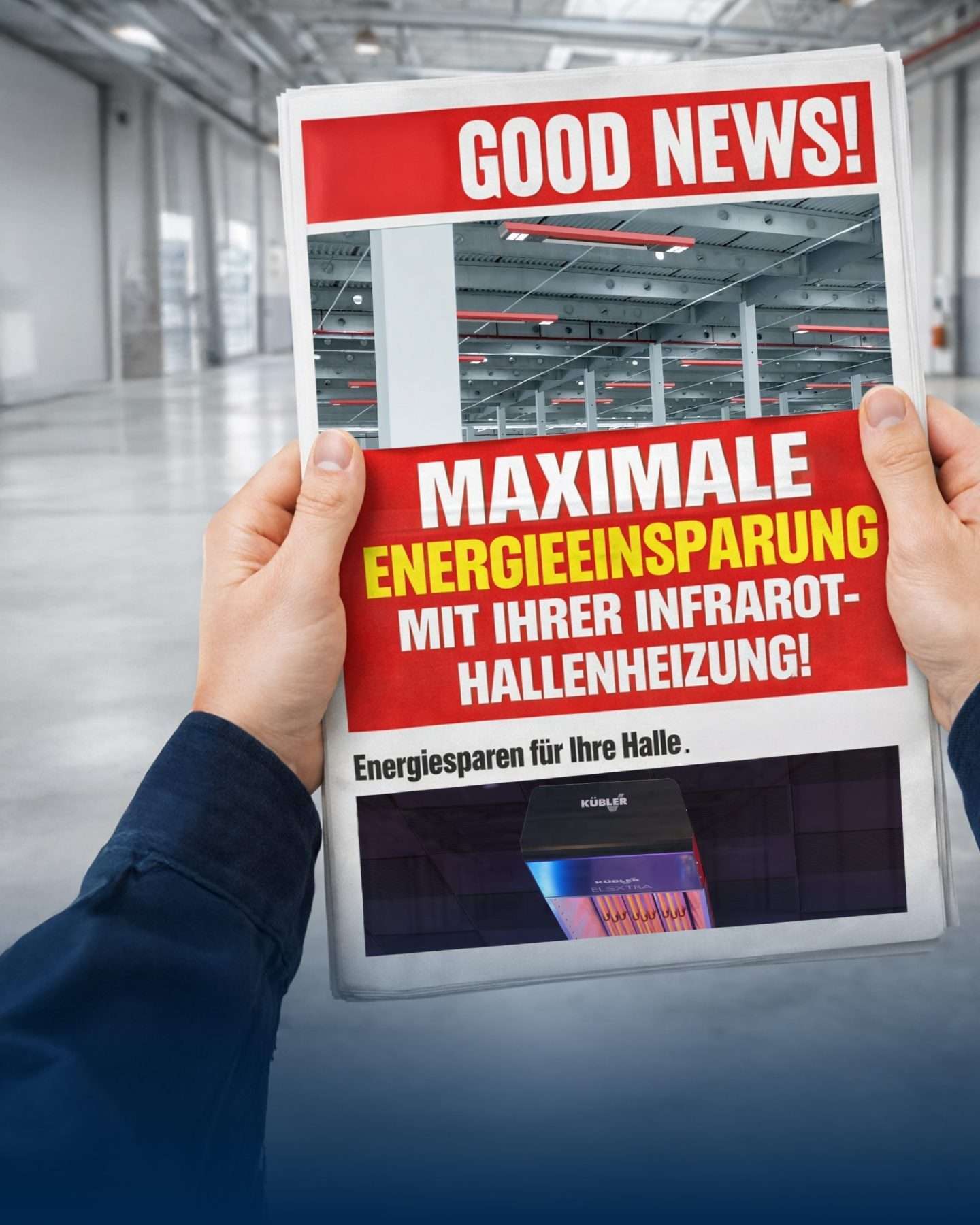
Maximum energy savings with your infrared indoor heating - here's how!
The good news for the new year first: If you already use a modern infrared indoor heating system, you benefit from a high energy-saving potential - regardless of the year the system was built. Current models offer even greater efficiency with smart controls and the option of integrating renewable energies. A replacement can therefore make sense, but you are also on the right track with your existing system.
Another piece of good news: you can reduce energy consumption even further by exploiting the full potential of your hall heating system. With these practical tips, you can do this effortlessly:
Tip 1: Optimize the heating times.
Infrared heaters only require short heating-up times and can be adapted precisely to requirements. Make sure that the heating times in your control unit match the actual working times.
Tip 2: Adjust the heating zones.
Not all areas in your hall require the same heating intensity. Switch off zones that are not used at certain times or on certain days.
Tip 3: Lower the temperature by 2 to 3 degrees.
You can achieve the same heat quality with an infrared heater at 15 to 16 °C instead of 18 °C. This saves additional energy without compromising on comfort.
Tip 4: Pay attention to the gate opening times.
Every time doors are opened, energy is lost unnecessarily. Reduce opening times and use smart tools such as TorOff to minimize heat loss.
Tip 5: Check windows and insulation.
Open windows or leaks in the building envelope allow a lot of energy to escape and cause cold bridges. Small repairs can quickly remedy this.
Tip 6: Consult experts!
For an optimal solution, you can turn to experts such as www.kuebler-hallenheizungen.de.
The best news at the end: If you implement these tips consistently, you will achieve significant savings with minimal effort - and create a pleasant working environment in your hall at the same time.
#Hall heating #Infrared heating # Energy Saving #Energy efficiency # Industrial Hall # Reduce heating costs