Infrared hall heating in your production: How to create the right indoor climate for your production
March 17, 2024

Industrial buildings are a world unto themselves. Especially in winter, their high ceilings pose a real challenge for anyone who wants to create the most comfortable working environment possible. But there are solutions—for example, infrared hall heating. First, however, you should ask yourself: What does a pleasant indoor climate actually mean? And what factors are decisive for this? There are various representations of this, which basically boil down to four different factors, which we will explain in more detail in this guide.
Hall buildings are a world of their own. Particularly in winter, their high ceilings pose a real challenge for anyone who wants to ensure the most pleasant working environment possible in the workplace. But there are solutions - for example, infraredHall heating. But first you should ask yourself: What does a pleasant indoor climate actually mean? And which factors are decisive for this? There are various explanations that basically boil down to four different factors, which we will explain to you in this guide.
4 factors that influence a pleasant indoor climate at the workplace
Basically, when it comes to a pleasant indoor climate in the workplace, you should always pay attention to these four factors:
- Temperature
- Air humidity
- Air movement
- Air quality
While the temperature is highly dependent on the type of activity (18 °C is sufficient for physical work, at least 20 °C is required when sitting), there is a consensus on the factors of humidity, air movement and air quality. 40 - 60 % humidity, air movement of no more than 0.15 m/s (at 21 °C) and an oxygen content of 21 % are guideline values that most people find pleasant and therefore constitute the optimum indoor climate at the workplace.
The right indoor climate at the workplace influences the productivity of your employees
It has been proven that a poor indoor climate in the workplace has a negative effect on your employees' motivation and performance. You will notice this at the latest when complaints are received or sick leave increases. Among many other organizations, the Federal Institute for Occupational Safety and Health (baua) has addressed this issue and writes the following in a report:
"Minor deviations from the "optimum climate" initially lead to discomfort, resulting in complaints about the climate (too hot, too cold, draughts). If these effects intensify and climate monotony or the inability to influence the climate yourself is added to this, this can lead to a high level of dissatisfaction, stress and psychological strain; motivation and satisfaction with one's own work decrease. Ultimately, the willingness to make an effort decreases, employees feel less productive and objectively measurable productivity losses and increased error rates can occur."
The problems you encounter when you want to create the optimum indoor climate in the workplace
Hall buildings are not easy to heat. Because the rooms are particularly large and high, it can also be particularly challenging to achieve the ideal indoor climate in the workplace. Find out below what problems arise when choosing a hall heating system.
Problem 1: The size of hall buildings as the biggest challenge for the indoor climate in the workplace
It is still relatively easy to positively influence the indoor climate in offices. However, if the workplace is a production hall, those responsible face completely different challenges. This is because the corporate goal of a "good working environment" faces headwinds from various directions:
- Large ceiling heights from 4 to 20 meters and more
- Long gate opening times
- Various work areas and hall zones
- Different building floor plans and layouts
- Dynamic temperature requirements
- Insufficient insulation, especially in old halls
- High pressure to reduce operating costs
- Legal regulations on decarbonization
Creating the optimum indoor climate in the workplace is therefore anything but easy in a production hall. Just keeping the temperature in such a building at a comfortable level is no trivial matter. Particularly because good and even heating is also important against the background of the Energy efficiency must be considered. Not to mention humidity, air movement and air quality.
Problem 2: Not every heating system contributes to a good indoor climate at the workplace
To the Hall heating A wide variety of technologies are used. However, they do not always deliver the desired results in terms of functionality, thermal comfort, and cost-effectiveness. They differ in terms of the type of energy source (heating oil, gas, wood, electricity, solar) and the type of supply: centralized or decentralized. Decentralized heating systems are now the technology of choice in many areas of application. Gas-powered infrared hall heaters of the dark radiator type play a particularly important role here, as they are specially designed for heating high-ceilinged rooms and offer significant advantages in this context. These advantages are also offered by the new generation of infrared hall heaters from the new Fair.AIdH*technology. Except that these can also be used effectively as a 2-in-1 system with integrated LED hall lighting and—more importantly—can be operated in an energy-flexible and renewable manner using electricity or hydrogen.
* Fair.AIdH* stands for the new energy-flexible heating technology for decarbonizing industrial buildings. The abbreviation stands for: Energy Flexible, adaptive, infrared, AI driven Hall heating.
No hot air: Why infrared indoor heaters are so good for the indoor climate in the workplace
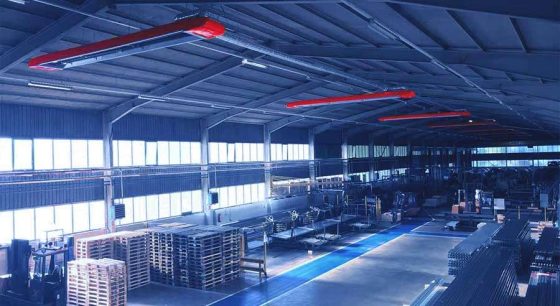
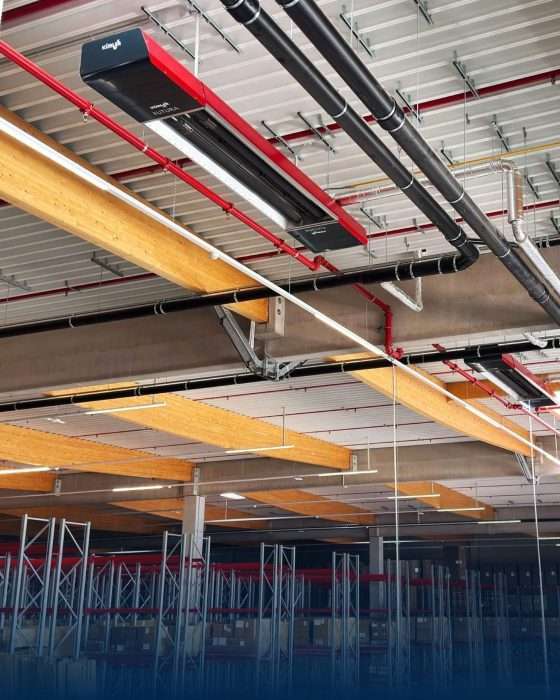
Infrared hall heaters are Radiant heaters. These heating systems transfer heat by emitting infrared radiation. As soon as the rays hit bodies or objects, they are converted into heat. The effect of infrared hall heaters is therefore similar to the heat principle of the sun, which does not heat the air but directly heats people, room frames, machines and other objects in the hall, resulting in a particularly pleasant indoor climate in the workplace.
Radiant heaters also have the decisive advantage in high rooms: where no air is heated, no warm air can rise high under the hall roof and form unused warm air cushions there - outside the working area. Infrared hall heaters are specially designed to bring heat evenly into the area of use. And nowhere else. Incidentally, this is also the key reason why these systems are so energy-saving and therefore so economical and environmentally friendly.
Infrared indoor heaters influence an optimal indoor climate in the workplace in many different ways
Consistent, targeted temperature control is not the only reason why infrared hall heaters ensure a pleasant indoor climate in the workplace. Because they do not generate warm air, these systems do not cause unpleasant drafts—and where there are no drafts, there is no dust swirling around that could affect air quality. Dust is almost everywhere – so this is an important plus point for the well-being and health of your employees as well as for the protection of your production machines. Another advantage for air quality is the closed combustion of the special type of infrared hall heater – and its associated feature that exhaust air is specifically discharged to the outside and does not remain in the hall building. This allows Waste heat incidentally - increasing efficiency - for other thermal processes, e.g. for hot water preparation (keyword: hybrid systems).
How to specifically control a good indoor climate at the workplace with an infrared indoor heating system
Infrared hall heating systems such as those developed by KÜBLER are rarely simple stand-alone solutions these days. They are digitally integrated into systems that enable a wide range of smart functions. This allows different areas of use to be defined in the halls, controlled in a targeted manner, and heated according to requirements (keyword: zone heating). Intelligent efficiency modules detect open hall doors, for example, and automatically switch off the heating until the doors are closed again. Depending on how long the doors are open, this can result in significant energy savings. Switch-on and switch-off times are now digitally optimized, and entire heating processes are monitored and analyzed for audits, e.g., in accordance with DIN EN ISO 50001. Humidity can also be regulated, which is useful if you store goods that are susceptible to corrosion, such as coils.
Create a pleasant indoor climate in the workplace with KÜBLER infrared indoor heaters
Infrared hall heaters can solve the many climatic challenges posed by hall buildings – after all, they have been specially developed for this particular application and thus contribute greatly to a pleasant working environment in the workplace. But they are more than just the basis for a good and productive indoor climate in the workplace. Today, infrared hall heaters are designed to bring maximum energy efficiency to your hall – and thus reduce costs and CO₂ emissions. The new energy-flexible Fair.AIdH*Systems are high-performance digital solutions that keep energy consumption so low that they pay off both ecologically and economically. Through scalable CO₂ reduction (up to 100% CO₂-free), low operating costs, and low TCO (total cost of ownership), they are now considered a key component of any sustainable financial and corporate strategy.
If you are also interested in a hall heating system that not only creates an ideal indoor climate in the workplace, but is also environmentally friendly, you should take a look at our KÜBLER infrared hall heating systems. With our heating systems, you are not only making the right choice for your employees, but also for the future of the planet.
Everything you need to know about energy-saving hall heating systems in practice
Saving energy is a big issue - across all sectors. If you want to put an end to inefficient heating systems, our guide is just right for you!
Request a free guide
You might also be interested in
-
 A new heating system for your company's hall is a decision that needs to be carefully considered. Read this article to find out which facts speak in favor of an infrared radiant heater!
 -
Operators of indoor heating systems are also responsible for having their system serviced regularly. In addition to operational safety, there are other good reasons why maintenance should not be put on the back burner!
-
 The German government is sticking to its goal of climate neutrality by 2045. The GMG is to come into force on 01.07.2026. The EU Buildings Directive (EPBD) will be implemented 1:1, making full use of national leeway. The requirements of the Heating Act (GEG §§ 71-71p) will be deleted. The obligation to operate new heating systems with at least 65 % renewable energy will no longer apply to new and existing buildings. Technology openness: Owners [...]
 -
 Germany has a huge number of buildings whose heating systems waste energy every day and produce far too much CO₂. With regard to the use of renewable energies and modern technologies, it is by no means just an old stock that urgently needs to be refurbished. Many newly built halls are also equipped with outdated [...]