Optimize hall heating: How companies can immediately save 60-70 % of operating costs despite high energy prices
April 22, 2026
Energy prices 2026: Why gas, electricity and oil will continue to rise and how companies should react now. Energy prices have come to a head once again. Contrary to many expectations, energy prices have not eased in the long term - on the contrary: new geopolitical tensions, particularly surrounding the Iran conflict, are significantly exacerbating the situation on the global energy markets.
The uncertainties in the Middle East in particular are having a direct impact on the price of oil and natural gas. Experts expect energy prices to remain under pressure in the coming months - with a clear upward trend.
Current forecasts show1):
- Natural gas prices could rise by +10 % to +30 % depending on market developments; at times, real price jumps of up to +65 % were recorded year-on-year
- Oil prices are particularly sensitive to geopolitical risks - possible increases of +15 % to +25 % are considered realistic
- Electricity prices remain under pressure due to high procurement costs and grid fees - companies must expect +5 % to +20 %
In addition, even if short-term easing occurs, the structural price level will remain high. Reasons for this include the restructuring of the energy supply, CO₂ pricing and rising infrastructure costs.
For companies, this means that energy remains a key cost factor - and an increasing risk for planning reliability. However, while energy prices can hardly be influenced, companies can optimize their own energy consumption in a targeted manner.
This is where one of the most effective measures comes in: Saving energy with the right hall heating.
Why classic hall heating systems are often inefficient
In production halls, logistics centers or sports facilities, the greatest energy losses often occur where they have long been overlooked: in hall heating.
Classic warm air systems - also in combination with a heat pump - work according to a simple principle - they heat the air in the entire room. However, this leads to considerable problems, especially in large halls with high ceilings:
- Warm air rises and remains unused
- Large room volumes are completely filled to the top with warm air
- The building must be permanently heated
- The coldest point in the hall is down in the work area, where it should be warm
- Air movement is often perceived as an unpleasant phenomenon
- Dust turbulence pollutes the working environment and contaminates the stored goods
The result: high heating costs with comparatively low efficiency. If you start here, you can significantly reduce the hall's heating costs.
Underfloor heating with a heat pump: why this type of heating makes less sense in halls
At first glance, underfloor heating in combination with heat pumps appears to be a modern and energy-efficient solution. This technology often makes sense in office buildings or residential properties - but it has clear weaknesses in large industrial halls, warehouses or logistics centers.
The main reason for this is the inertia of the system. Underfloor heating systems work with low flow temperatures and require long heating-up times. In halls with changing use, open doors or irregular operating times, this leads to considerable efficiency losses. Heat is often not available exactly when it is needed.
What's more:
- Large hall areas must be fully heated - even unused areas
- High investment costs for technology and installation, high maintenance costs
- Limited responsiveness to dynamic usage requirements
- Heat pumps lose efficiency at low outside temperatures
- Thermal conductivity and comfort in halls often inadequate
Another crucial point is the lack of zoning. While modern hall heating systems specifically heat individual, defined work areas, underfloor heating always heats the entire area. This unnecessarily increases energy consumption - especially with rising energy prices for electricity. They also restrict the use of the hall floor, e.g. for machine changeovers.
In industrial environments in particular, underfloor heating and heat pumps are therefore not usually an economically optimal solution for halls when it comes to rapid availability, flexible use and maximum energy savings. In comparison, modern radiant heating systems offer clear advantages in terms of efficiency, comfort, reaction speed and targeted heat supply.
Optimize hall heating: The key to lower energy costs
Modern hall heating takes a fundamentally different approach. Instead of heating the air, the heat is directed to where it is needed: to people, work areas and machines.
This principle significantly reduces wastage and at the same time ensures a more pleasant feeling of warmth. Companies benefit twice over:
- Lower energy consumption
- better working conditions
Especially against the backdrop of rising energy prices, it is clear that those who optimize their hall heating can save costs in the long term and become less dependent on market prices.
Infrared hall heating: Efficient alternative for industry and logistics
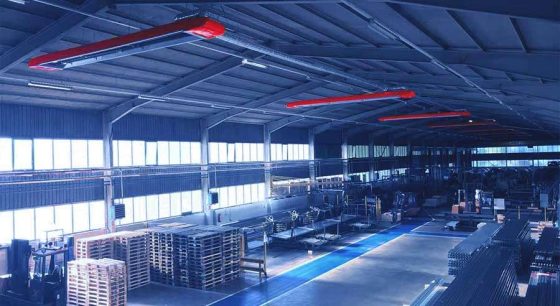
One of the most efficient technologies in this area is infrared or radiant heating. It works in a similar way to the sun: it is not the air that is heated, but the surfaces on which the natural heat radiation hits.
This brings decisive advantages:
- Instant heat without long heat-up times
- Uniform temperature distribution directly in the usable area
- No „heating under the ceiling“: virtually no heat loss due to rising warm air
- Ideal for commercial and industrial halls, sports halls and event buildings
For many companies, infrared hall heating is therefore one of the most effective answers to the question: How can energy be saved in the industrial hall?
Practical solution: Intelligent hall heating with Fair.AIdH technology
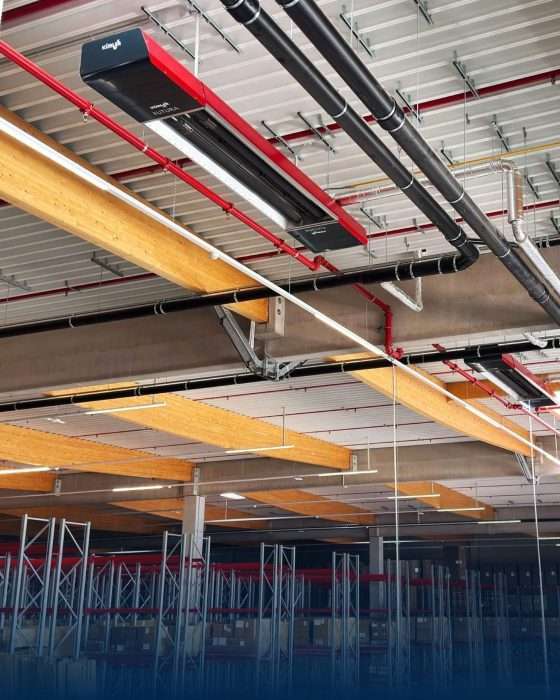
One example of a particularly advanced solution is the Fair.AIdH technology from KÜBLER GmbH. Here, efficient radiant heating is combined with energy flexibility and intelligent digital control. The aim is not just to provide heat, but to reduce energy consumption across the board. Above all, however, this technology is designed for the economical decarbonization of hall buildings.
The main advantages at a glance:
- Energy-flexible use of various energy sources from electricity to H2 or (biogenic) gases
- Integrated hall lighting in the sustainable 2in1 system as an option
- 50 to +70 % Energy and cost savings
- Targeted heating instead of wasting energy
- Only hall areas that are actually used are heated
- Significantly reduced heating costs thanks to minimized heat loss and high efficiency
- Rapid availability of heat
- No long heat-up phases as with classic systems
- Scalable CO₂ reduction up to 100 % carbon free
- Future security
- Adaptable to new requirements and energy sources
This transforms hall heating from a pure cost factor into an active component of a company's energy and climate strategy.
Cost-effectiveness: when a modern hall heating system pays off
The question is no longer whether companies should invest in energy-efficient technology - but when.
This is because even small efficiency gains quickly add up to considerable savings, especially in large hall areas. In many cases, modern systems pay for themselves much more quickly than expected.
Companies also benefit from:
- Increasing planning security for energy costs
- possible funding programs
- long-term increase in the value of the infrastructure
Energy-efficient hall heating is therefore not just an investment, but a strategic advantage.
Conclusion: Saving energy starts with the hall heating
Experts estimate that energy prices will remain volatile in the long term. However, companies that act now can secure decisive advantages.
Optimizing hall heating is one of the most effective ways to save energy and reduce costs in the long term. Modern technologies such as the Fair.AIdH solution show how efficiency, economy and sustainability can be combined.
Investing in the right hall heating today not only reduces your energy costs - it also strengthens your competitiveness tomorrow.
Sources:
Exchange gas price: Will electricity and gas now become more expensive?
IEA warns Iran war oil shock will cut supply, cause demand to shrink | Reuters
Everything you need to know about energy-saving hall heating systems in practice
Saving energy is a big issue - across all sectors. If you want to put an end to inefficient heating systems, our guide is just right for you!
Request a free guide
You might also be interested in
-
 A new heating system for your company's hall is a decision that needs to be carefully considered. Read this article to find out which facts speak in favor of an infrared radiant heater!
 -
Operators of indoor heating systems are also responsible for having their system serviced regularly. In addition to operational safety, there are other good reasons why maintenance should not be put on the back burner!
-
 The German government is sticking to its goal of climate neutrality by 2045. The GMG is to come into force on 01.07.2026. The EU Buildings Directive (EPBD) will be implemented 1:1, making full use of national leeway. The requirements of the Heating Act (GEG §§ 71-71p) will be deleted. The obligation to operate new heating systems with at least 65 % renewable energy will no longer apply to new and existing buildings. Technology openness: Owners [...]
 -
 Germany has a huge number of buildings whose heating systems waste energy every day and produce far too much CO₂. With regard to the use of renewable energies and modern technologies, it is by no means just an old stock that urgently needs to be refurbished. Many newly built halls are also equipped with outdated [...]