"Innovations are made in the SME sector!"
May 6, 2024
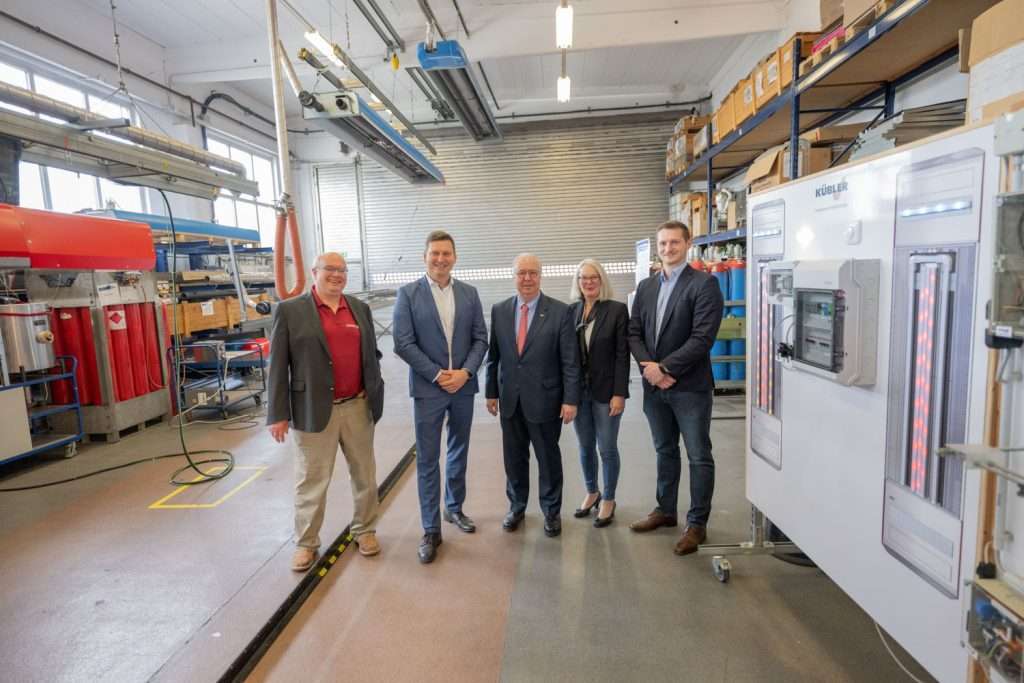
Ludwigshafen, 29 April 2024 | Mario Brandenburg, Member of the German Bundestag and Parliamentary State Secretary, in conversation with Thomas Kübler, Dr. Steffen Manser (KÜBLER GmbH) and Prof. Dr. Matthias Rädle (CeMOS) on the topic of research, development and what is needed to reduce CO₂ in industry and commerce.
The R&D department of the hall heating specialist KÜBLER has grown to six engineers: since 2007, there have been continuous cooperation projects with renowned institutes such as CeMOS, Mannheim University of Applied Sciences (with 70 engineers the largest research center at a university of applied sciences in Germany) or the Technical University of Kaiserslautern, often funded by the AiF, for example. Tens of millions of euros have been successfully invested in the research budget in recent years - no wonder that the key innovations in the field of climate-friendly hall heating have been coming from the development center in Ludwigshafen for decades and that the company is regarded as a technology and innovation leader.
For Mario Brandenburg, Member of the German Bundestag and Parliamentary State Secretary at the Federal Ministry of Education and Research, this was the reason for the company visit to KÜBLER. But the talks were not just about "... the advertising blog for our latest innovations and AI projects", as Thomas Kübler put it. The entrepreneur was concerned with future development projects at a time when funding is becoming increasingly scarce. Dr. Steffen Manser, Team Leader for Hardware & Software Development at KÜBLER, and Prof. Dr. Matthias Rädle, Head of the CeMOS Institute at Mannheim University of Applied Sciences and long-standing research partner of KÜBLER, were also present.
When it comes to hydrogen ramp-up, everyone agrees in view of the huge PV summer electricity surplus that is rolling towards Europe: "The idea of the future is to store this PV electricity in the form of hydrogen centrally via existing gas grids or decentrally and then use it as 'green gas' for heating during slack periods and in winter," says Rädle. With enormous ecological and economic advantages, because with the new energy-flexible infrared heaters, hydrogen is converted directly into radiant heat without transformation losses and without a fuel cell - and also very cleanly without waste. Of course, the gas networks would have to be upgraded in places, but "... this is not rocket science. With today's technologies and methods, it's relatively easy to do," says Rädle, who is also head of the Steinbeis Transfer Center "Intelligent Industrial Solutions" and the KVE - Competence Center Virtual Engineering. State Secretary Mario Brandenburg: "Hydrogen is a major focus topic - especially with regard to the heat transition. I therefore consider the exchange with KÜBLER to be very important and informative."
But SMEs are facing major challenges. Innovation is also being held back by outdated standards. Innovations for decarbonization should be marketable and accessible much faster today. "This is where politicians need to provide unbureaucratic support for dissemination," says Thomas Kübler. If products that are urgently needed for the energy transition cannot be established on the market, innovation in Germany will no longer make sense. Mario Brandenburg also sees a need for action here and wants to provide support. Because, according to the MP: "Medium-sized companies are clearly the backbone of the German economy. This is where innovations are made".
Everything you need to know about energy-saving hall heating systems in practice
Saving energy is a big issue - across all sectors. If you want to put an end to inefficient heating systems, our guide is just right for you!
Request a free guide
Interested in our press photos?
Would you like to download all images from the article in the highest quality? Simply click on the button below and enjoy our press photos in the highest resolution!
You might also be interested in
-
 While the public debate has so far focused heavily on residential construction, specific questions arise for industrial and logistics companies: what are the implications for large-volume non-residential buildings such as production and logistics halls? Thomas Kübler, an expert in energy-efficient hall heating systems, explains the key points from a practical perspective. Climate neutrality remains the guiding principle The German government is sticking to its goal of climate neutrality [...]
 -
 „Anyone who is nominated for the ‘Großer Preis des Mittelstandes’ belongs to the elite of German SMEs. This nomination alone is already an award of the highest quality,“ emphasizes Barbara Stamm, President of the Bavarian State Parliament. Outstanding achievements in five areas In the competition, the KÜBLER company is assessed in its entirety and its role within society. The [...]
 -
 Ludwigshafen - Clear messages, clear expectations: At the annual reception of the Rhineland-Palatinate Economic Council at the main site of KÜBLER GmbH, host Frederic Renz had clear words to say about the economic situation. „SMEs need what all companies in Germany urgently need: a clear direction and reliable political framework conditions. If you want economic growth, you have to create planning security,“ emphasized the Managing Director of the hall heating specialist. Around [...]
 -
 Heating halls efficiently, economically and functionally is a challenge. Because in these huge buildings with ceiling heights that often reach 20 meters, a lot of energy can quickly be consumed - energy that is expensive and, depending on the heating technology used, also causes high emissions. The building stock is often still equipped with inefficient and [...]