The coalition agreement is in place - good news for heating warehouse buildings and logistics properties
April 10, 2025
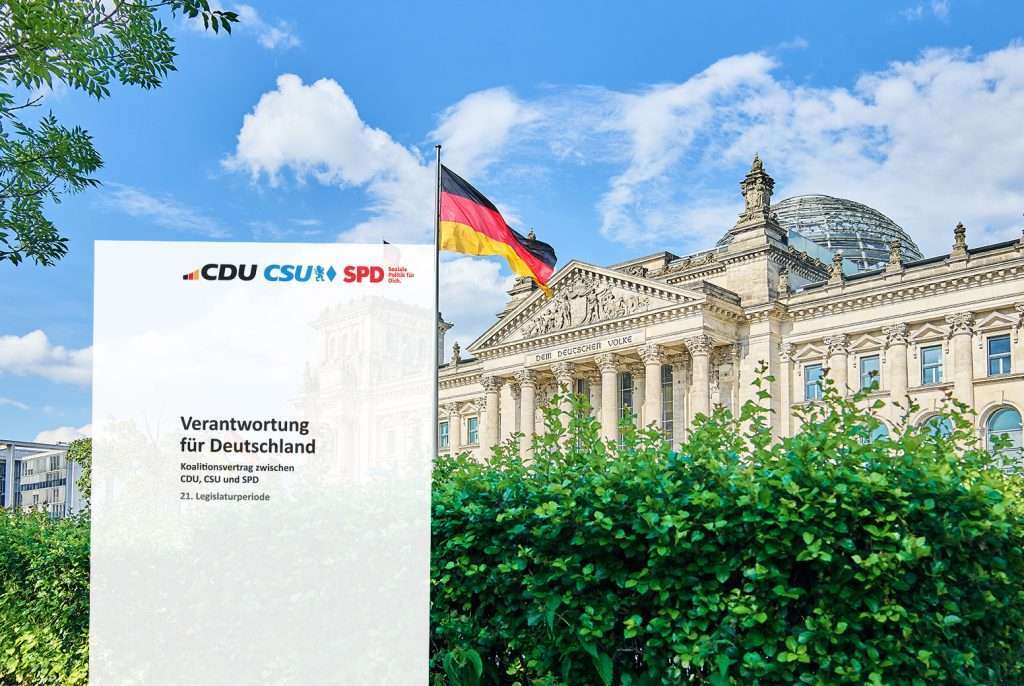
Too timid and too slow for some, for others the basis for "a government with the ability and strength to act" - it is hardly surprising that assessments of the coalition agreement between the CDU, CSU and SPD drift far apart in some cases. The relevant media and networks cannot be critical enough anyway. Everything is torn apart at first. There is no lack of opinions, but often a lack of competence. The fact is, however, that there is a lot of good in the 146-page paper, which was presented yesterday by the coalition partners under the motto "Responsibility for Germany". But what does the coalition agreement mean for the heating transition in Germany and for the users of industrial buildings? What can developers and operators of large industrial or commercial properties expect from it? What does it mean for innovative manufacturers? Our experts have examined the coalition agreement for you with regard to these questions. Here are the relevant points in brief:
Climate protection remains highly relevant for the new German government. The previous climate targets are confirmed - in the full knowledge that global warming is a global problem and that the international community must work together to solve it. Climate protection should bring together economic competitiveness and social balance, with a focus on innovation. The commitment that Germany should remain an industrialized country and at the same time become climate-neutral is important. The plan to keep energy costs moderate in future underlines this.
The next German government wants to exploit all the potential of renewable energies. This includes solar and wind energy as well as bioenergy, geothermal energy, hydropower and molecules produced from these. In our view, this should be seen as a further development, as the traffic lights were still primarily focused on electrification ("electrons") and the topic of hydrogen ("molecules") was only taken into consideration much later and hesitantly. This turnaround is illustrated by the following sentence in the coalition agreement: "For the rapid ramp-up of the hydrogen economy, we need climate-friendly hydrogen from various sources. [...] The long-term goal is to switch to climate-neutral hydrogen, based on a growing share of renewable energy from domestic and imported sources. We want to produce hydrogen both via large electrolysis plants that serve the system and also increasingly decentralized and comprehensive." It also states: "Germany should play a leading role in a European hydrogen initiative."
The building sector remains central to achieving the climate targets. Affordability, openness to technology, Security of supply and climate protection are the new and important goals for the modernization of the heating supply. The new GEG should finally be more open to technology, more flexible and simpler. The achievable CO₂ reduction is to become the key control variable., which will hopefully be a shortcut in this matter. The current GEG focuses on replacing CO₂-emitting energy sources with the obligation to use a defined percentage of renewable energies. This detour blocked the way for other possibilities. We consider the use of CO₂ emission reduction as a direct control variable to be very targeted and it is now becoming „Europe-compatible.“ The national building efficiency classes in the GEG are to be harmonized with neighboring countries, and the existing scope of the European Building Directive (EPBD) is to be fully utilized.
The renovation and heating subsidy is to be continued (KTF) and energy-related renovations to inherited properties will be tax-deductible in future.
Our conclusion: There are many good new approaches in the area of construction and renovation, such as accelerating construction, simplifying the GEG in a way that is open to all technologies, maintaining the necessary gas infrastructure, strengthening and planning security for hydrogen and, above all, recognizing and being open to innovation and new technology in combination with simpler legislation. We see promising, pragmatic solutions here. The same applies to turning away from the detailed regulatory frenzy of the past, which would never have managed to reflect the individuality of the technologies for the countless different applications.
It remains to be seen whether the changed framework conditions for halls in particular will make it possible to establish a separate, urgently needed technical building class in the non-residential construction sector alongside multi-storey buildings. But the signs are good. Simplifying outdated, bureaucratic standards such as V 18599 in the short term is also a major challenge. The repeatedly emphasized need to speed up the energy transition with innovations requires a fast track for outdated standards via development applications, as well as the technological opening of the "innovative heating technology" category in the BEG.
If we dare to cut off old beards in order to remove bureaucracy and obstacles to innovation by thinking about the results, we will make faster progress with the energy transition. Only then would it be possible to write a success story with "Energy Transition made in Germany"!
Everything you need to know about energy-saving hall heating systems in practice
Saving energy is a big issue - across all sectors. If you want to put an end to inefficient heating systems, our guide is just right for you!
Request a free guide
You might also be interested in
-
 The uncertainties in the Middle East in particular are having a direct impact on the price of oil and natural gas. Experts expect energy prices to remain under pressure in the coming months - with a clear upward trend. Current forecasts show1): Natural gas prices could rise by +10 % to +30 % depending on market developments; at times, [...]
 -
 A new heating system for your company's hall is a decision that needs to be carefully considered. Read this article to find out which facts speak in favor of an infrared radiant heater!
 -
Operators of indoor heating systems are also responsible for having their system serviced regularly. In addition to operational safety, there are other good reasons why maintenance should not be put on the back burner!
-
 The German government is sticking to its goal of climate neutrality by 2045. The GMG is to come into force on 01.07.2026. The EU Buildings Directive (EPBD) will be implemented 1:1, making full use of national leeway. The requirements of the Heating Act (GEG §§ 71-71p) will be deleted. The obligation to operate new heating systems with at least 65 % renewable energy will no longer apply to new and existing buildings. Technology openness: Owners [...]