Infrared hall heating or heat pump?
October 7, 2025
Heating commercial properties in compliance with the GEG
Politically promoted, often problematic in practice: heat pumps quickly reach their limits in halls. Properly understood, the GEG leaves room for technological openness—and this is precisely where infrared hall heating systems come into their own.
Existing buildings: No obligation to use renewable energies
On the way to CO2In terms of free time, energy efficiency is perhaps the most important pillar of decarbonization—because, as „low-hanging fruit,“ efficiency measures to reduce CO2 usually simpler, faster, and more cost-effective than substitution with renewable energies. For this reason, high-efficiency solutions such as infrared hall heating systems from KÜBLER, which have been proven to achieve energy savings of at least 40 percent, are exempt from the obligation to use renewable energies (see GEG § 71m (2) Energy efficiency in the overall system).
Newly constructed halls: Infrared beats heat pumps
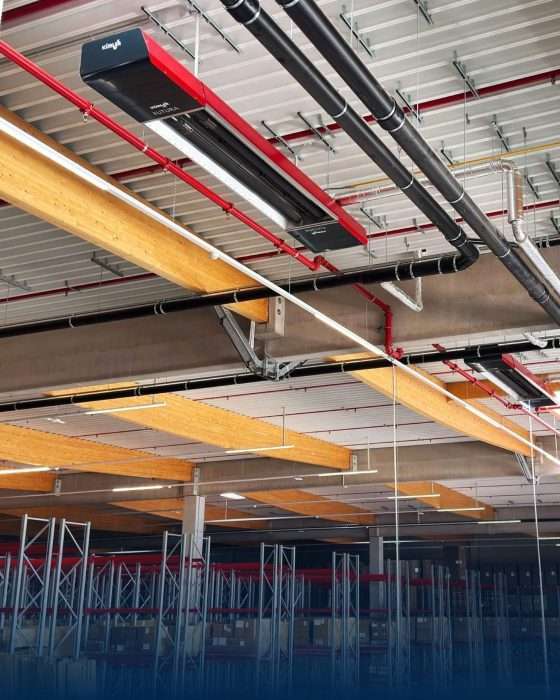
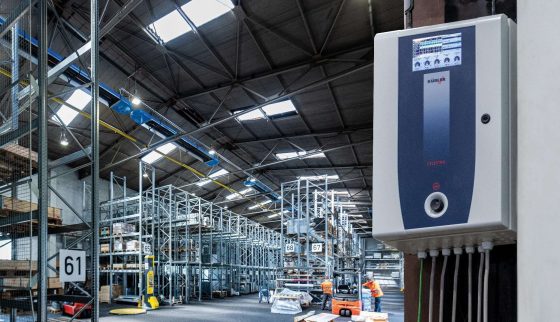
With FUTURA, FUTURA E, or ELEXTRA featuring the new Fair.AIdH technology, solutions are available for new buildings that use electricity and other renewable energies such as H2 can be operated, are at least as efficient as heat pumps, and at the same time offer all the advantages of decentralized infrared hall heating systems, which are so important for heating halls.
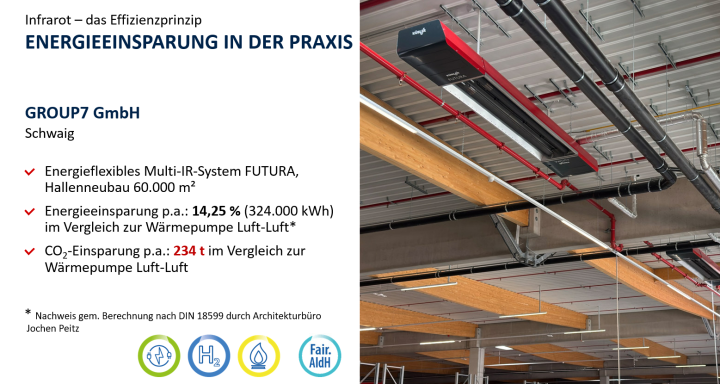
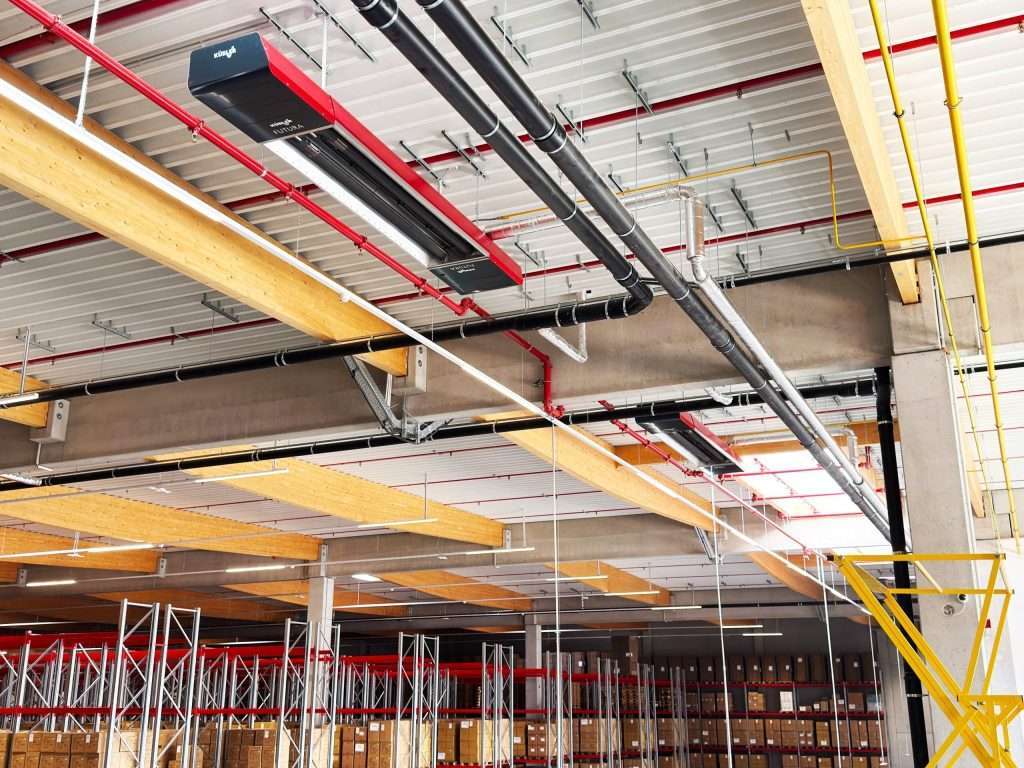
The new GROUP7 logistics hall was built in accordance with the DGNB Gold Standard and is heated using energy-flexible infrared hall heating technology (Fair.AIdH FUTURA). The savings mentioned are even higher in practice. Calculation: Jochen Peitz Architects, 42853 Remscheid.
(Source: KÜBLER GmbH Energy-saving hall heating systems)
Conclusion: Infrared is superior in halls for good reasons
|
|
|
|
|
|
|
|
|
|
|
|
|
|
Conclusion: Heat pumps can be an excellent solution for heating homes, offices, or other low-rise buildings in a climate-friendly way. However, they are not particularly suitable for large halls with their enormous dimensions and ceiling heights. In these buildings, technologies that have been specially developed for their demanding heating requirements are the best choice. Infrared hall heating systems are the most popular of these.
Everything you need to know about energy-saving hall heating systems in practice
Saving energy is a big issue - across all sectors. If you want to put an end to inefficient heating systems, our guide is just right for you!
Request a free guide
You might also be interested in
-
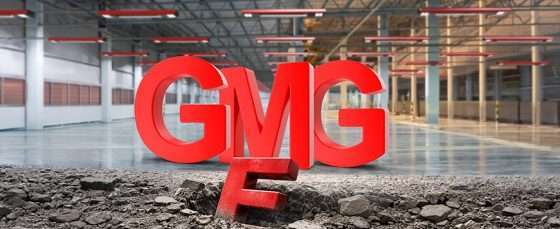
 The German government is sticking to its goal of climate neutrality by 2045. The GMG is to come into force on 01.07.2026. The EU Buildings Directive (EPBD) will be implemented 1:1, making full use of national leeway. The requirements of the Heating Act (GEG §§ 71-71p) will be deleted. The obligation to operate new heating systems with at least 65 % renewable energy will no longer apply to new and existing buildings. Technology openness: Owners [...]
 -
 Germany has a huge number of buildings whose heating systems waste energy every day and produce far too much CO₂. With regard to the use of renewable energies and modern technologies, it is by no means just an old stock that urgently needs to be refurbished. Many newly built halls are also equipped with outdated [...]
 -
Mr. Kübler, your company produces heating systems for halls. These only make up a small proportion of all buildings in Germany. Why is it nevertheless important to save as much energy as possible in this area? That's right, halls only make up around 1.5 percent of all buildings in Germany, so most people don't notice them. Even [...]
-
 Christmas is once again approaching surprisingly quickly - and, unfortunately, one or two challenges are on the horizon. From 3G and 2G plus to the next increases in energy prices. Congratulations if you have already converted your hall heating to an economical system from KÜBLER. This is a really good decision in many respects.