The „Golden Plan“ - How sports facilities are really promoted today
April 28, 2026
A support program that still has an impact today
Anyone who deals with the financing of sports facilities will sooner or later come across the term „Golden Plan“. For decades, it symbolized the systematic expansion of sports grounds, halls and swimming pools in Germany. However, anyone looking for a specific funding program with this name today will quickly discover that the „Golden Plan“ has long since ceased to exist in its original form.
However, this does not mean that the funding of sports infrastructure has lost any of its importance. On the contrary, the structure of the funding landscape has changed fundamentally. A central, nationwide program has evolved into a flexible system that functions on several levels and is based on cooperation between the federal, state and local authorities. Particularly in the area of Renovation of existing sports halls topics such as energy efficiency and climate protection play a central role today.
From a development program to a modern funding landscape
The historic „Golden Plan“ was introduced at the end of the 1950s to remedy the massive shortage of sports facilities after the war. At the time, there was a lack of basic infrastructure for popular sports in many places, especially for children and young people.
This goal has largely been achieved, which is why the content of the funding has evolved. Today, the focus is less on new buildings and more on modernizing existing facilities. In particular, this involves
- Energy optimization
- Reduction of CO₂ emissions
- Sustainable and future-proof building technology
- Accessibility and multifunctional use
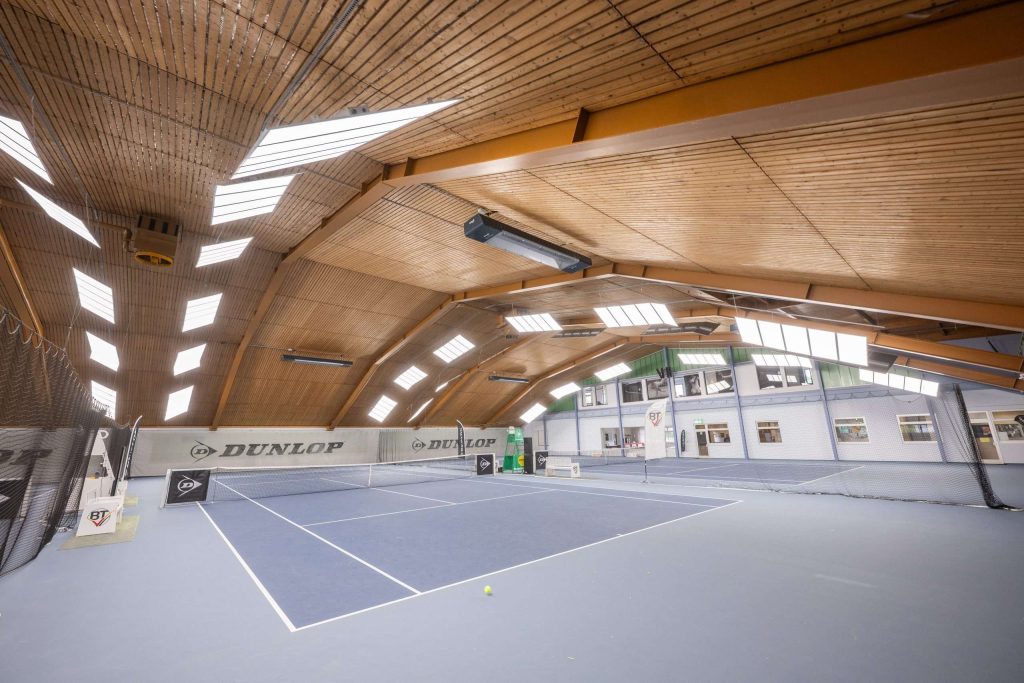
There is great potential here, particularly in the area of building technology - for example, in hall heating. Modern heating systems that are based on radiant heat and can be flexibly adapted to different times of use can make a significant contribution to reducing energy consumption and are therefore becoming increasingly relevant in the context of renovations.
Modern heating systems as the key to eligible refurbishment
An often underestimated but decisive lever in the renovation of sports halls is the choice of the right heating system. While the focus is often on the building envelope and lighting, the hall heating system offers particularly great potential for saving energy and reducing CO₂ emissions.
Sports halls present special challenges: They are rarely used continuously, but are subject to strongly fluctuating occupancy times. At the same time, large room heights and volumes are typical, which makes classic warm air heating systems inefficient. A considerable proportion of the heat generated rises unused below the hall roof, while the actual areas of use remain comparatively cool.
Modern heating systems, especially those based on radiant heat, are designed to do just that. They do not primarily heat the air, but directly the people and surfaces in the occupied area. This results in several advantages:
- Significantly lower energy consumption, as heat is targeted to where it is needed
- Fast response times, ideal for changing training and occupancy times
- Heating in zones, only the playing field or individual parts of the hall
- Reduced heat loss, especially for large hall heights
- Improved thermal comfort without draughts or strong air movement
In addition, modern systems such as Fair.AIdH technology are increasingly enabling the use of different energy sources and can be integrated into sustainable energy concepts in the future - for example by combining them with renewable energies or future technologies such as hydrogen.
These characteristics contribute directly to key funding criteria. Measures that demonstrably contribute to Energy saving, CO₂ reduction and sustainability of buildings are given special consideration in many programs.
This makes it clear that the decision for an efficient, sports hall-specific heating system is not just a technical question, but a strategic component - both for economic efficiency in operation and for successful integration into modern funding programs.
The structure of funding today
Today, funding is based on an interplay between various institutions. In particular, the federal government provides funds for major renovation projects and for energy-efficient measures ready. Programs for energy-efficient building refurbishment or CO₂ reduction are often a key component of the financing.
However, the main responsibility lies with the federal states, which design their own funding programmes for new construction, renovation and modernization. Municipalities and associations implement the measures locally and usually bear their own share.
The decisive factor here is:
The more a project contributes to energy saving and climate protection, the better the chances of funding in many cases.
Baden-Württemberg: Promoting the future
Baden-Württemberg is a clear example of the modern funding structure. Funding is provided via association funding and municipal funding.
Clubs receive grants from the Baden-Württemberg State Sports Association for:
- New construction of sports facilities
- Refurbishment and modernization
- Energy measures such as lighting or heating systems
- Accessibility measures
Efficient heating solutions are becoming increasingly important, particularly in the area of energy-efficient refurbishment. In sports halls, which are often only used occasionally, conventional warm air systems can lead to high energy losses and also costs, for example due to unused heating of the hall air or heat losses under the ceiling.
This is where modern, zonable radiant heating systems offer advantages: they specifically heat the areas where athletes spend their time, enable a quick response time for changing use and at the same time significantly reduce energy requirements. Such properties contribute directly to the funding criteria in the area of energy efficiency and climate protection.
Supplemented by the state youth plan
In addition to infrastructure funding, there is also the state youth plan, which supports youth work in sports clubs. Funding is provided for educational measures, projects and smaller purchases, among other things.
Even if construction projects are not the focus here, it is clear that sports promotion today is considered holistically - from infrastructure to use. Modern, well-tempered sports halls in particular help to create attractive training conditions and improve usage by different target groups.
Municipal sports facility subsidies
At municipal level, the state supports the construction and renovation of sports halls and other facilities. The focus is particularly on
- Renovation of existing sports facilities
- Energy modernization
- Multifunctional utilization concepts
The choice of heating technology plays a key role, particularly when it comes to energy modernization. Systems that enable demand-based, zone-by-zone heating and can also be combined with different energy sources not only help to reduce operating costs, but also to achieve climate targets in the long term.
In addition, innovative heating solutions that also integrate renewable energies or alternative energy sources in the future can significantly increase the sustainability of a sports hall - an aspect that is increasingly being taken into account in funding decisions.
Promotion as a combination of several building blocks
Today, funding is usually provided through a combination of different funding sources. Projects are planned individually and coordinated with different programs.
Refurbishments in particular offer the opportunity to meet several subsidy requirements at the same time through targeted measures - for example in the area of heating technology:
- Energy saving
- CO₂ reduction
- Sustainable building technology
- Improving the quality of use
This can significantly improve the profitability of a project and increase the likelihood of funding.
Making targeted use of structural subsidies - setting the right course now
The days of simple funding programs are over - today's structures offer significantly more scope for well thought-out, sustainable solutions. For local authorities, clubs and operators, this means that those who approach refurbishment projects strategically can not only make optimum use of funding, but also improve the long-term profitability of their sports facilities.
A key lever here is the technical equipment - especially the hall heating. Modern, needs-based controllable systems make it possible to precisely coordinate energy consumption, use and comfort. This not only reduces operating costs in the long term, but also has a direct impact on a project's eligibility for funding.
However, it is crucial to correctly classify this potential at an early stage and to transfer it into a coherent overall concept. This is precisely where an external perspective pays off: with sound advice, technical possibilities, funding requirements and economic goals can be brought together in a meaningful way.
If you would like to know how your sports hall can be upgraded to make it more energy-efficient and which funding options are specifically available for your project, contact a hall heating specialist such as KÜBLER for advice. You can find information and contact details at www.kuebler-hallenheizungen.de. The experts will work with you to develop a solution that exactly matches your usage, your budget and your funding objectives.
Sources:
Sports facility funding: EU, federal and state programs (2026)
Promotion of municipal sports facility construction | Baden-Württemberg regional councils
Sports facility construction funding from the WLSB
Funding for sports facility construction: Tips for clubs | Sports facility calculator
„Golden Plan East“ was an important federal sports policy project
Promotion of sports facilities . Supervisory and Service Directorate
Everything you need to know about energy-saving hall heating systems in practice
Saving energy is a big issue - across all sectors. If you want to put an end to inefficient heating systems, our guide is just right for you!
Request a free guide
You might also be interested in
-
 The uncertainties in the Middle East in particular are having a direct impact on the price of oil and natural gas. Experts expect energy prices to remain under pressure in the coming months - with a clear upward trend. Current forecasts show1): Natural gas prices could rise by +10 % to +30 % depending on market developments; at times, [...]
 -
 A new heating system for your company's hall is a decision that needs to be carefully considered. Read this article to find out which facts speak in favor of an infrared radiant heater!
 -
Operators of indoor heating systems are also responsible for having their system serviced regularly. In addition to operational safety, there are other good reasons why maintenance should not be put on the back burner!
-
 The German government is sticking to its goal of climate neutrality by 2045. The GMG is to come into force on 01.07.2026. The EU Buildings Directive (EPBD) will be implemented 1:1, making full use of national leeway. The requirements of the Heating Act (GEG §§ 71-71p) will be deleted. The obligation to operate new heating systems with at least 65 % renewable energy will no longer apply to new and existing buildings. Technology openness: Owners [...]