FUTURA in Trier: First multi-energy infrared system for climate-neutral heating of halls in operation
April 27, 2023
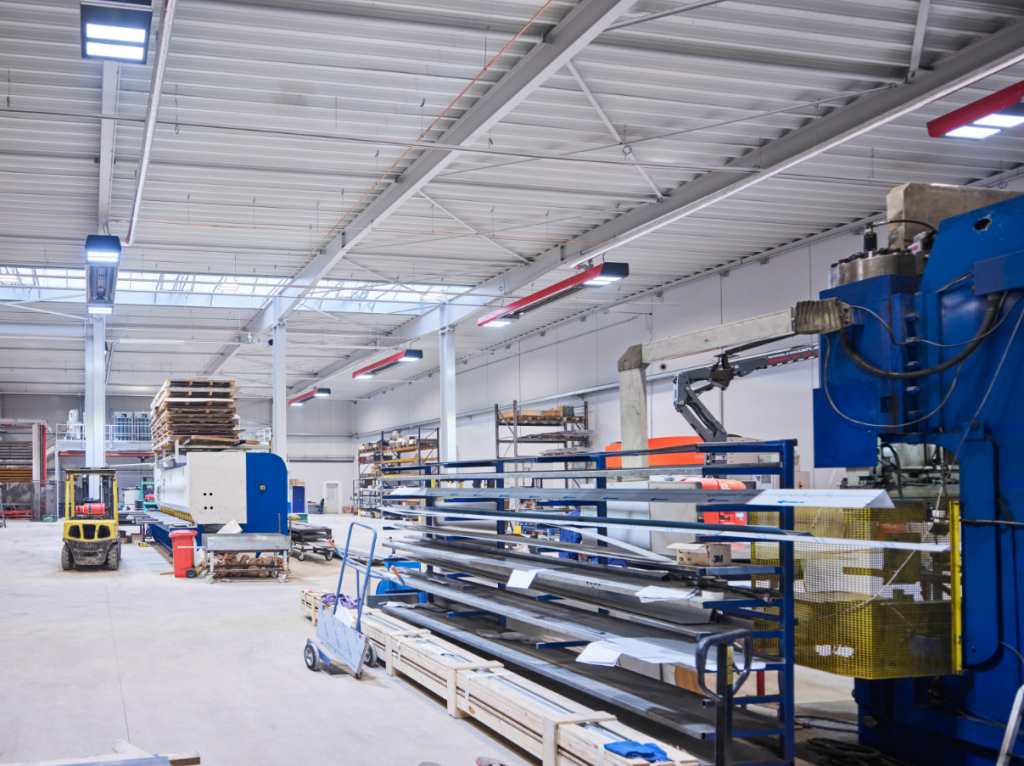
The metalworking company "Die Kanter & und Schlosser" heats its new building variably with electricity, hydrogen or gas thanks to the world innovation from KÜBLER in Ludwigshafen.
„Our motto is progress“ is the slogan of the forward-looking metalworking specialist in Trier.
The company has also applied this standard to the new 2,800-square-meter hall, which has been in production since 2022. From building insulation to the PV system, from state-of-the-art fiber laser technology to nitrogen self-generation, the highest energy efficiency standards are implemented here. One of the most important components in this regard is the hall heating system. However, the process of getting to this point has all the makings of a corporate thriller.
"Initially, we were still thinking about an underfloor heating/heat pump combination to heat the new halls. After all, it is considered energy-efficient and is subsidized by the state," says Christoph Rotsch, Commercial Director at "Die Kanter". However, after consulting with the regional installation partner, it quickly became clear that different technology would have to be used for hall buildings with their huge room dimensions than for living rooms, offices or kindergartens. He therefore contacted KÜBLER, a proven expert in energy-saving infrared heating technology for industrial halls. The decision in favor of the high-efficiency system was made. That was at the end of June.
"We have implemented a whole host of energy efficiency measures in the new hall, from PV to insulation and machine technology. We clearly wanted the same for the heating."
However, the entrepreneur had done the math without the Federal Ministry of Economics. The Ministry was concerned with the future of gas heating systems and their usefulness. "Kanter & Schlosser" withdrew the contract two weeks after it was awarded. "The uncertainty surrounding the gas supply was simply too great for us," says Christoph Rotsch. KÜBLER then surprised everyone with a world first - developed even before the energy crisis. "In my opinion, we produce the most efficient systems for heating halls. And we have now opened up our high-efficiency technologies to the use of renewable energies," says Thomas Kübler, founder and managing partner of the KÜBLER Group. Obviously at exactly the right time.
"When we got to know FUTURA, underfloor heating was off the table."
"Die Kanter & Schlosser" became a pilot project. "We are always breaking new ground ourselves with many of our projects. We are happy to help shape the process at KÜBLER," says Christoph Rotsch. "When we got to know the FUTURA, underfloor heating was off the table."
The pilot in question is a multi-energy infrared system, also known as multivalent. A world first that builds the bridge to a carbon-free future. It is not for nothing that the new technology bears the name FUTURA. The energy-efficient infrared heating system can use renewable energies such as electricity or hydrogen. At the same time, biogas, natural gas or liquid gas can also be used, switching variably between the energy sources. This works both in mono mode and in a mix. Depending on which energy is currently available or particularly cost-effective. "In this way, we ensure security of supply and stabilize the grids," says Kübler. "But above all, our solution is economical."
"We are thus ensuring security of supply and stabilizing the grids. But above all, our solution is economical."
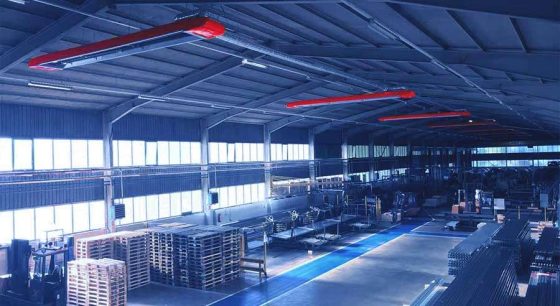
The multivalent system in Trier went into operation just in time for the 2022/2023 heating period: the infrared systems function from the hall ceiling in the same way as the sun, which heats everything that is illuminated - people, machines and the hall floor. This means that the heat comes simultaneously from above, below and from all sides. This heat transfer is energy-efficient with savings of 50 to 70 percent. "With the FUTURA, we heat flexibly in terms of time and location," says Kübler, "because we only cover the heat demand that actually exists. After all, the most efficient heating system is the one that isn't running."
"With FUTURA, we heat flexibly in terms of time and location, because we only cover the heat demand that actually exists. After all, the most efficient heating system is the one that isn't running."
The heating is switched on according to demand when and where heat is required. It is controlled via the CELESTRA control system, which has been expanded with modules such as WinTec for remote control. The EMMA heat management system was also installed. It provides "Die Kanter & Schlosser" with full real-time transparency of the entire heating process and makes all data available to the management for audits, such as in accordance with DIN EN ISO 50001.
"The best thing for us is that we can now heat with different energies. In future, we will be able to decide flexibly which is the most favorable for us and when."
"We had full confidence in KÜBLER's more than 30 years of experience right from the start," says Rotsch. Now, around three months after commissioning the new system, "Die Kanter & Schlosser" is very satisfied with the decision. "The best thing for us is that we can now heat with different energies. In future, we will be able to decide flexibly which is the most favorable for us and when." With FUTURA, companies are no longer reliant on gas alone. "We currently only heat with electricity. Now in winter, the PV system covers all our costs from around eleven o'clock onwards." In the old building, the heating had previously blown circulating air into the hall. Every time the door was opened, it got really cold and it felt like it took half an eternity to warm up inside again. "We definitely have a completely different heat quality in the hall now. Much more pleasant, much more localized and no more swirling dust. This has also been very well received by the employees."
"We definitely have a completely different heat quality in the hall now."
Rotsch cites the ability to individually heat the various work areas in the hall building or even switch them off when operations are finished as another important advantage. "We have defined four different heating circuits that we can control with the FUTURA system. It saves us a lot of energy if, for example, the metalworking shop stops earlier on Fridays and the heating can be switched off specifically in this area." Wasting energy would be out of the question for the future-oriented company. This is another reason why they are glad to be away from technologies such as underfloor heating, which cannot be controlled according to demand and has to run at night or even at weekends.
"We have already recommended the new FUTURA technology to others and would do so again and again."
The managing director of the innovative hall heating company KÜBLER cannot understand the uncertainty that currently exists in the market. „We have been providing the industry with tried-and-tested solutions for a long time that can reduce energy consumption and CO₂ emissions by up to 70 percent and more.“ But the current crises have thrown politicians into such disarray that urgently needed energy-efficient renovations are being put on hold because it is unclear what will and will not be permitted in the future. At the same time, renewable energies are not yet widely available or sufficient for heating processes in industry and commerce,“ says Thomas Kübler. „What is certain is that heat pump technology is not a real alternative in industrial buildings. If only because it takes away any flexibility for companies to be able to repurpose hall areas or change machine layouts in the future.“ But heat pumps are also unattractive from an economic point of view, regardless of whether they are combined with underfloor heating or radiant ceiling panels. „Companies have to reckon with an investment that is three to four times higher than necessary. And this is with much poorer usability, but with comparable energy efficiency.“
And the conclusion from "Die Kanter & Schlosser"? Christoph Rotsch: "We have already recommended the new FUTURA technology to others and would do so again and again."
Everything you need to know about energy-saving hall heating systems in practice
Saving energy is a big issue - across all sectors. If you want to put an end to inefficient heating systems, our guide is just right for you!
Request a free guide
You might also be interested in
-
 A funding program that still has an impact today Anyone who deals with the financing of sports facilities will sooner or later come across the term „Golden Plan“. For decades, it symbolized the systematic expansion of sports grounds, halls and swimming pools in Germany. But anyone looking for a specific funding program with this name today will quickly discover that [...]
 -
 The uncertainties in the Middle East in particular are having a direct impact on the price of oil and natural gas. Experts expect energy prices to remain under pressure in the coming months - with a clear upward trend. Current forecasts show1): Natural gas prices could rise by +10 % to +30 % depending on market developments; at times, [...]
 -
 A new heating system for your company's hall is a decision that needs to be carefully considered. Read this article to find out which facts speak in favor of an infrared radiant heater!
 -
Operators of indoor heating systems are also responsible for having their system serviced regularly. In addition to operational safety, there are other good reasons why maintenance should not be put on the back burner!